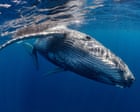
Scientists filming off Australia's Gold Coast last July captured rare underwater footage of a humpback whale mother remaining beside her stillborn calf for an extended period. The behavior raises questions about whether cetaceans experience grief, though researchers caution that alternative explanations exist for what observers documented.
The video showed the mother whale stationary near the motionless newborn on the seafloor approximately one kilometer from the Queensland coastline. Olaf Meynecke, a marine biologist who analyzed the footage, notes the mother's persistent presence near the dead calf. Such extended maternal attendance at a deceased offspring remains poorly documented in humpback whales, making this encounter scientifically notable.
Meynecke, writing for the Conversation, acknowledges the interpretation challenge. The observed behaviors could represent genuine grief, but they might also reflect maternal attachment, confusion about the calf's condition, or instinctive caregiving responses that persist despite the calf's death. Distinguishing between these explanations requires caution. Whales possess complex social structures and demonstrated capacity for learning, memory, and communication, yet attributing human emotions to animal behavior carries methodological risks.
Humpback whales undertake migrations spanning roughly 16,000 kilometers annually. Calves born during breeding season in Australian waters depend entirely on mothers for nutrition and guidance. A stillbirth represents a reproductive failure with energetic costs to the mother. How cetaceans process such losses neurologically and behaviorally remains largely unknown territory in marine science.
Previous research documents that some cetacean species carry deceased offspring for periods ranging from hours to days. Orca pods have been observed maintaining deceased calves near the surface, appearing to support the bodies. Dolphins similarly exhibit behaviors suggesting recognition of death. These observations cluster around species with matriarchal social structures and extended maternal investment in offspring.
The Gold Coast footage adds to an emerging body of anecdotal evidence. Systematic studies quantifying the frequency and duration of such behaviors remain absent. Scientists lack standardized protocols for distinguishing grief from other causal mechanisms. Neuroimaging data comparing whale brains during loss experiences does not exist. The absence of such research does not disprove emotional responses. It reflects funding constraints and the technical difficulty of studying large marine mammals in open ocean conditions.
The footage's value lies partly in documentation itself. Marine biologists depend on opportunistic observations because controlled experiments with whales are ethically impossible and logistically infeasible. Video records provide data points for future comparative analysis. If similar behaviors appear consistently across multiple humpback populations and contexts, patterns would emerge supporting emotion-based interpretations over alternatives.
Recognizing potential cetacean grief carries conservation implications. Legal protections for whales rest partly on their cognitive sophistication and capacity to suffer. Evidence of emotional complexity strengthens arguments for marine protected areas and whaling restrictions. Conversely, overinterpreting animal behavior through anthropomorphic lenses risks creating false certainty where ambiguity actually exists.
The stillborn calf on Australia's seafloor represents one mother whale's loss and one scientist's careful observation. The footage documents something real. Whether that reality encompasses grief, in the human sense, remains an open question in cetacean research.