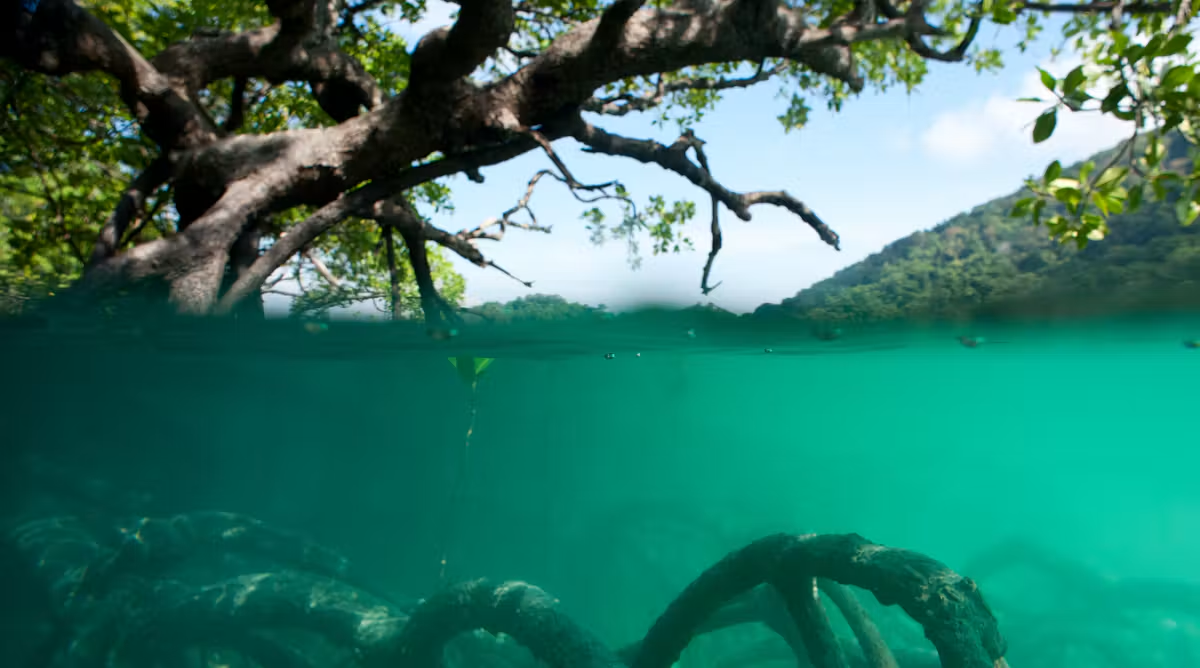
Mangrove forests and urban trees protect coastal and urban areas from climate impacts at a fraction of the cost of concrete seawalls and dams, according to research cited in this article.
Mangrove forests naturally dampen storm surges. Protection from existing mangrove forests is worth an estimated A$1.2 trillion over 100 years. Planting mangroves typically costs less than 50% of concrete and steel equivalents for the same protection, while avoided property damage can be 10 to 100 times greater than planting costs.
Grey infrastructure designed for past climate conditions increasingly fails as weather patterns shift. Coastal defences built for mid-20th century storm surges are being breached with growing regularity. In 2022, severe summer downpours caused water infrastructure failure in Jackson, Mississippi. Intense cloudbursts turned streets into rivers in Saitama, Japan this year. Living systems adapt to new rainfall and temperature patterns rather than simply failing.
New York City spent roughly A$2.1 billion protecting forests and plants in its watershed in the 1990s, avoiding the need to build a conventional filtration plant that would have cost A$8.6-11 billion.
Without adaptation efforts, encroaching seas could cause more than $27 trillion in damage globally. By 2100, sea levels will rise about 0.6 metres above 2000 levels if greenhouse emissions drop sharply, or 2.2 metres if they do not.
Urban trees reduce heat. Singapore's plan to plant a million trees by 2030 is predicted to cut outdoor heat stress by 3-5°C and reduce summer air-conditioning energy use by 6-9%. In Colombia, green corridors planted along roads and waterways reduced average temperatures 2°C, returning $1.7 in avoided health costs for every $1 spent.
The Brazilian Amazon rainforest's rainfall and water recycling is worth about $20 billion a year, supporting agriculture, power generation and water supplies. When forests are cut down, silt washes into rivers and fills hydropower dams, reducing power generation.
Governments favour grey infrastructure because of established engineering standards and contractual certainty. Green infrastructure benefits such as avoided flood risks often are not included in accounting frameworks used for procurement decisions. Politics and inertia remain the biggest blockers, the authors state.