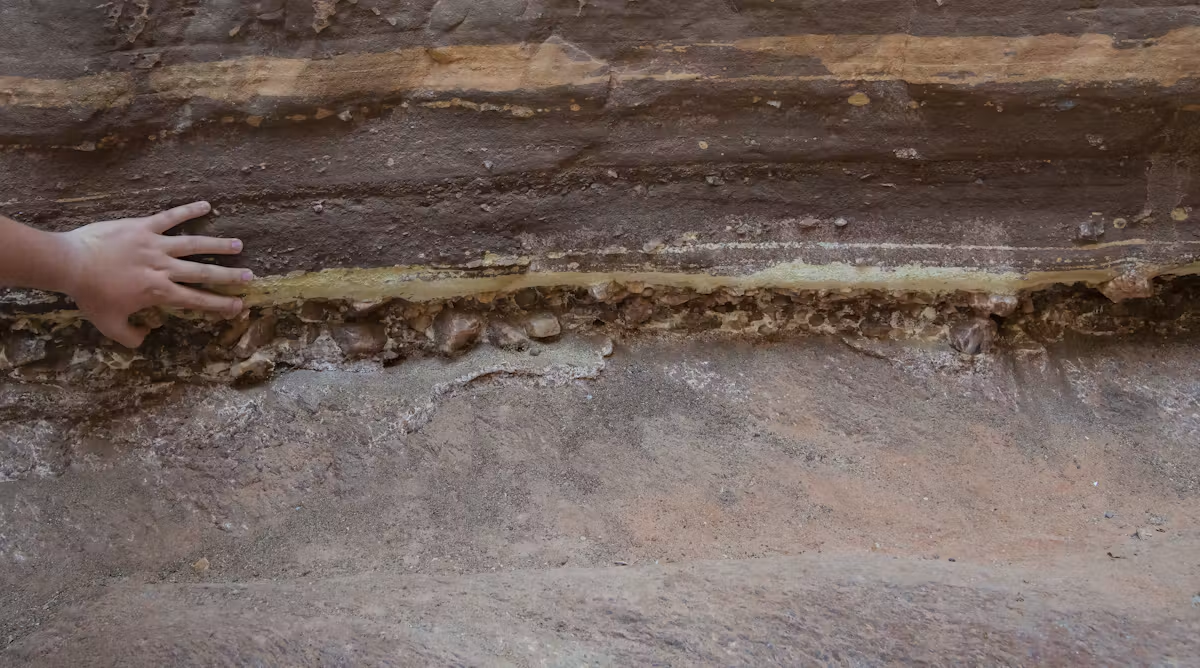
Researchers from the University of Wollongong have identified the cause of the Great Unconformity, a gap in Earth's rock record spanning up to a billion years that has puzzled geologists since the 1870s.
The Great Unconformity appears in many places worldwide, including the Grand Canyon, where rock layers from two different ages hundreds of millions of years apart sit directly atop each other. In some locations, roughly a quarter of Earth's geological history is missing from the rock record.
The team used Australia's Gadi supercomputer to model mantle convection over the past billion years. Their results showed that slow movement of Earth's mantle lifted three ancient continental blocks, Laurentia (now much of North America), Baltica (parts of northern Europe), and North China, from around a billion years ago to 540 million years ago. The mantle then pulled these blocks downward over the past 540 million years.
When continents were lifted up, crystalline rock at depth was exposed at the surface, and sediment layers above were eroded away. As the blocks later sank, new sediment layers formed and were preserved.
The uplift coincided with the Snowball Earth period between 720 million and 635 million years ago, when massive ice sheets covered continents. Ice sheets eroded rock more efficiently than rivers, scraping away material across the uplifted landscape.
Australia and South America experienced only two cycles of uplift and subsidence from 900 million years ago. The researchers found little evidence of the Great Unconformity on these continents, consistent with their model predictions.
The findings were published in Nature.