Parasites and fungi alter the behavior of living hosts in ways that benefit the parasite's reproduction, though they do not control hosts through a single mechanism.
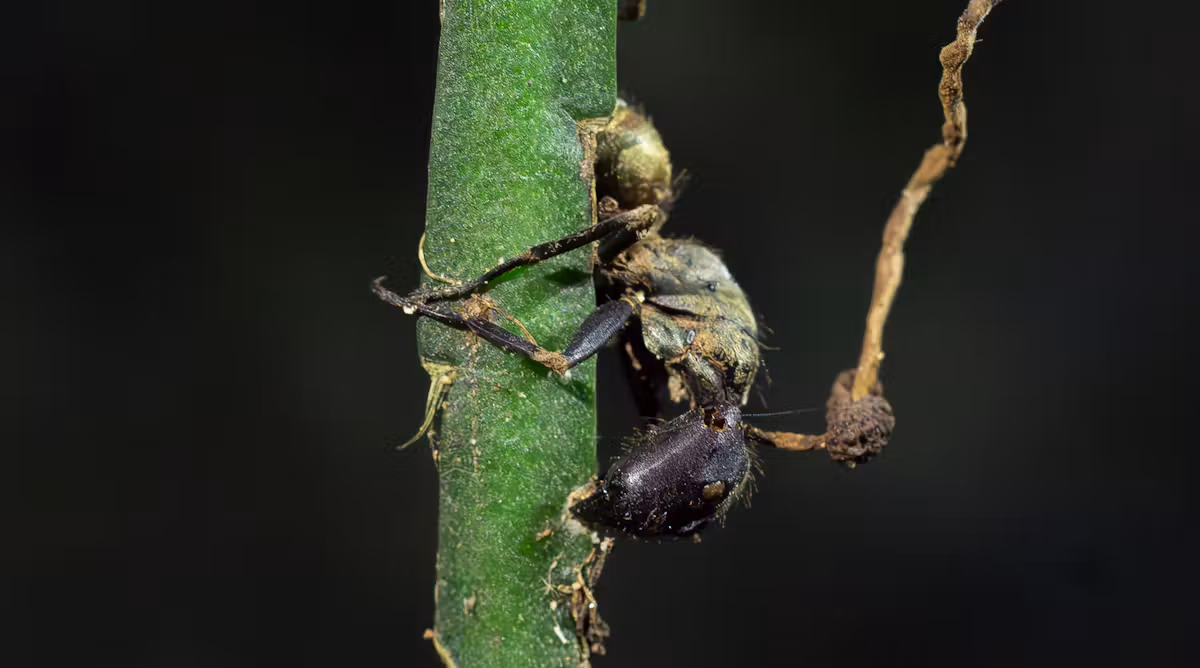
The zombie ant fungus, Ophiocordyceps, infects ants and causes them to leave their colony, climb vegetation, and bite onto plant surfaces in a "death grip" before dying. The fungus then consumes the ant's tissues and releases spores from a stalk growing out of the body. Researchers found extensive fungal growth throughout infected ants' bodies and around muscle fibers, but not inside the brain. Fungal cells form networks around muscles, suggesting behavior manipulation involves communication between the fungus and multiple host tissues rather than direct brain control. Jaw muscles of infected ants show signs of extreme contraction and possible release of fungal molecules, yet motor neurons and nerve-muscle connections often remain intact. Scientists have not yet proved exactly how the fungus causes the full sequence of wandering, climbing and biting.
The emerald jewel wasp injects venom into cockroach nervous systems, reducing activity in parts involved in starting movement. The cockroach can still walk but loses the drive to do so, allowing the wasp to lead it to a burrow for egg-laying.
Hairworms infect praying mantises and crickets. When ready to reproduce, infected hosts become attracted to light and enter water, where the worm escapes to begin its life cycle. The host may drown. Studies found changes in brain proteins as the parasite manipulates sensory and behavioral machinery.
Toxoplasma gondii infects warm-blooded animals but reproduces in cats. Infected rodents lose their natural aversion to cat odors and may become attracted to them, increasing the chance they are eaten by cats.
Studying these examples helps scientists understand how parasites manipulate hosts and how normal behavior is generated and controlled.