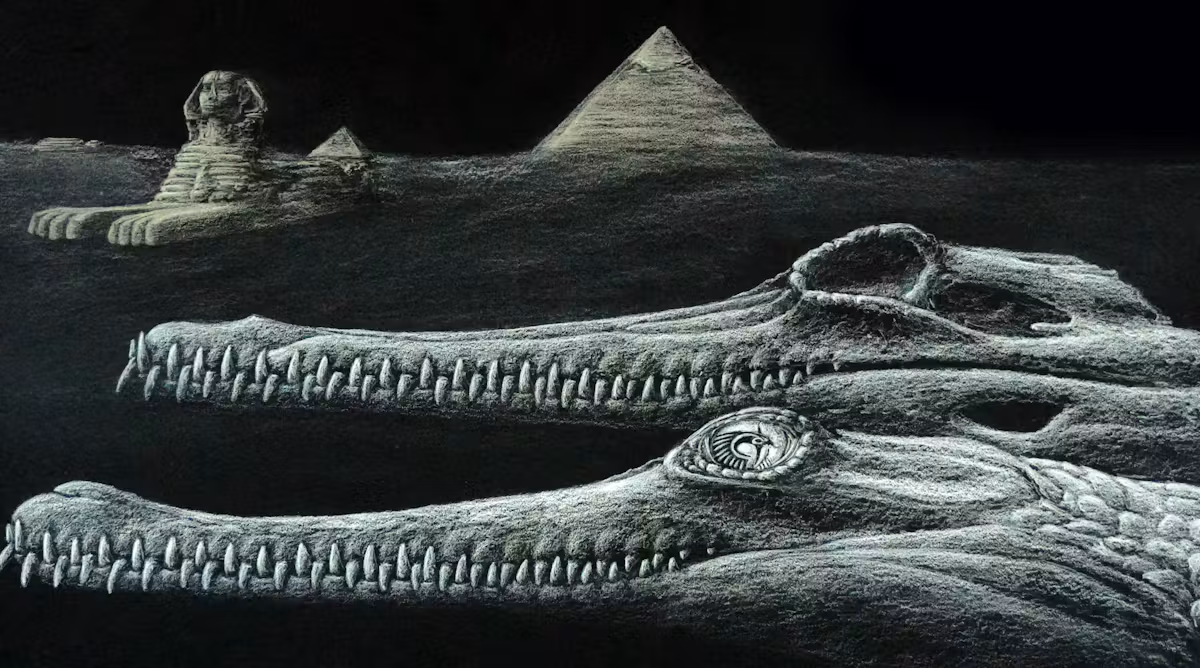
A new extinct crocodile species discovered in Egyptian limestone rocks sheds light on how gavials once thrived across the globe but are now restricted to two endangered species in freshwater habitats.
Researchers led by Paul Burke at the Swedish Museum of Natural History re-examined fossils collected in the 1920s from northeastern Egypt. The fossils came from the Mokattam Formation, a limestone layer that formed 45 million years ago in a shallow marine environment. The same rocks were quarried 4,500 years ago to build the Great Sphinx of Giza.
Using CT scans, the team identified anatomical differences from modern gavials, including raised rims around the eye sockets. They named the species Herugavialis cairensis, after the Egyptian falcon-headed god Heru, because like the Sphinx, the fossil skull is missing the tip of its snout.
The fossil record shows gavials existed for 80 million years and once comprised more than 40 species distributed worldwide. Living gavials cannot tolerate saltwater, yet fossil evidence from inner ear structures suggests some extinct species could survive in oceans.
Northern Africa and southern Europe hosted diverse gavial populations during much of the past 80 million years, thriving in shallow marine environments across the Mediterranean region. Crocodiles disappeared from the Mediterranean around 6 million years ago during the Messinian salinity crisis, when the Mediterranean dried up after being sealed from the Atlantic Ocean. Heightened evaporation made seawater too salty for animals to survive, killing crocodiles and other species. The region remains saltier than oceans today, with crocodiles absent from it ever since.
Living gavials lost the adaptations needed to tolerate saltwater, leaving them dependent on freshwater environments far from the Mediterranean.