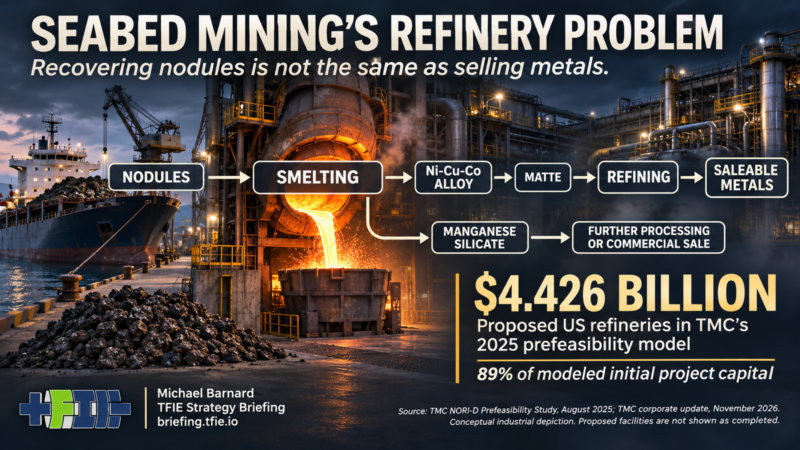
The Metals Company's November 2026 update revealed a critical flaw in seabed mining economics that the industry has worked hard to minimize: there is no viable refinery when the nodules start arriving. TMC's proposed Brownsville, Texas facility may not be operating when offshore collection begins. Its backup plan—using a modified Japanese smelter operated by Pacific Metals—requires significant modifications and aligned schedules that remain unconfirmed. This is not a minor logistical hiccup. It exposes a fundamental truth that seabed mining advocates have glossed over: the refinery problem is worth billions, and someone must solve it before the first nodule leaves the ocean floor.
The numbers tell the story. TMC's 2025 prefeasibility study allocated $4.426 billion to two proposed US hydrometallurgical refineries—approximately 89% of the study's $4.971 billion in initial project capital. These are not abstract figures. They represent the actual industrial infrastructure required to transform wet nodules into saleable metals. The 2025 study projected an additional $13.622 billion in lifetime processing costs and $3.254 billion in refining costs, together accounting for about 42% of modeled operating expenditure. The economic center of gravity does not sit offshore with the collectors. It reaches deep into the onshore industrial chain, where processing plants consume capital, energy, reagents, skilled labor and working capital.
What makes this worse is the value gap between raw nodules and refined metals. Using estimated purchase terms informed by analogous mineral markets, nodules from the Clarion-Clipperton Zone have a modeled raw-feed value of $188–256 per ton—only 34–46% of their contained-component reference value. The gap pays for real industrial work. Processors bear metal recovery losses, treatment costs, plant capital, financing, product quality and operating risk. They need a return. TMC cannot simply hand off this burden to someone else and claim its economics work.
The company faces three choices, none of which eliminates the problem. It can sell raw nodules at whatever price a processor will accept. It can keep title and pay a processor under contract, but that only transfers risk allocation, not the underlying capital and work. Or it can finance and operate refining facilities itself. Those are the only paths forward. Government financing might redistribute risk, but it cannot change what must be built or operated.
History offers a warning. Ravensthorpe, Goro and Ambatovy all used familiar metallurgical technologies, yet encountered expensive commissioning and operational difficulties. Seabed nodules present an unusual feedstock with high-volume throughput requirements, uncertain manganese outlets and synchronized offshore-and-onshore ramp-up challenges. TMC has more testing and better-developed partners than Impossible Metals, which matters. But neither company has demonstrated a fully operating processing chain at intended scale, recovery, capital cost and commercial terms.
Investors, taxpayers and processing partners deserve transparency. Who provides the billions in capital? Who carries the ramp-up risk? How much metal value does the collector retain after every participant is paid? Until seabed mining companies answer these questions directly, their economics remain incomplete speculation masquerading as business plans.