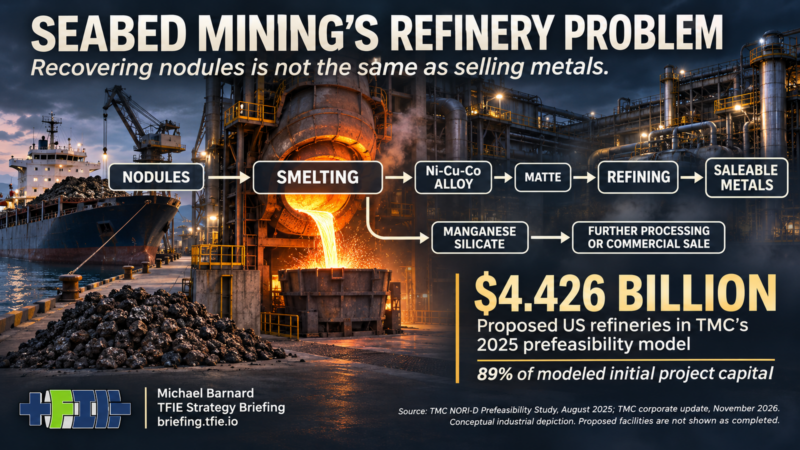
The Metals Company projects seabed mining operations to begin in 2026, but its refining capacity may not be ready. The company allocated $4.426 billion, about 89% of its $4.971 billion initial project capital, to two proposed US hydrometallurgical refineries in its 2025 prefeasibility study. A refinery complex in Brownsville, Texas, may not operate when offshore collection starts.
TMC's alternative is to use an existing Japanese smelter operated by Pacific Metals. That facility requires modifications to handle commercial volumes. PAMCO has completed feasibility work on treating roughly 1.3 million wet tons per year through a modified existing facility.
Processing nodules into saleable metals involves multiple steps. Nodules are smelted into nickel-copper-cobalt alloy and manganese silicate, converted into matte, and refined into marketable metals or chemicals. Each step requires capital, energy, reagents, skilled labor and working capital.
TMC conducted metallurgical testing on about 70 tons of nodules and a 2,000-ton industrial demonstration at PAMCO's Hachinohe facility. SGS in Canada tested refining intermediate material into battery-grade products.
The company faces three options. It can sell raw nodules to a processor. It can retain title and pay a plant to process the material under contract. Or it can finance and operate its own refining facilities to capture more finished-metal revenue. All three options require billions in onshore industrial capital and carry ramp-up risk.
TMC's 2025 study projected $13.622 billion in lifetime processing costs and $3.254 billion in refining costs, together about $103 per wet ton, or 42% of modeled operating expenditure. Processing costs sit alongside proposed refinery capital.
Comparable nickel projects faced expensive commissioning and operational difficulties. Ravensthorpe, Goro and Ambatovy encountered challenges despite using familiar metallurgical technologies. High-volume throughput, uncertain manganese outlets and synchronized offshore-onshore ramp-up add complexity for nodule ventures.
TMC has more testing and more developed partners than competitor Impossible Metals. Neither company has demonstrated a fully operating processing chain at intended scale, recovery, capital cost and commercial terms.