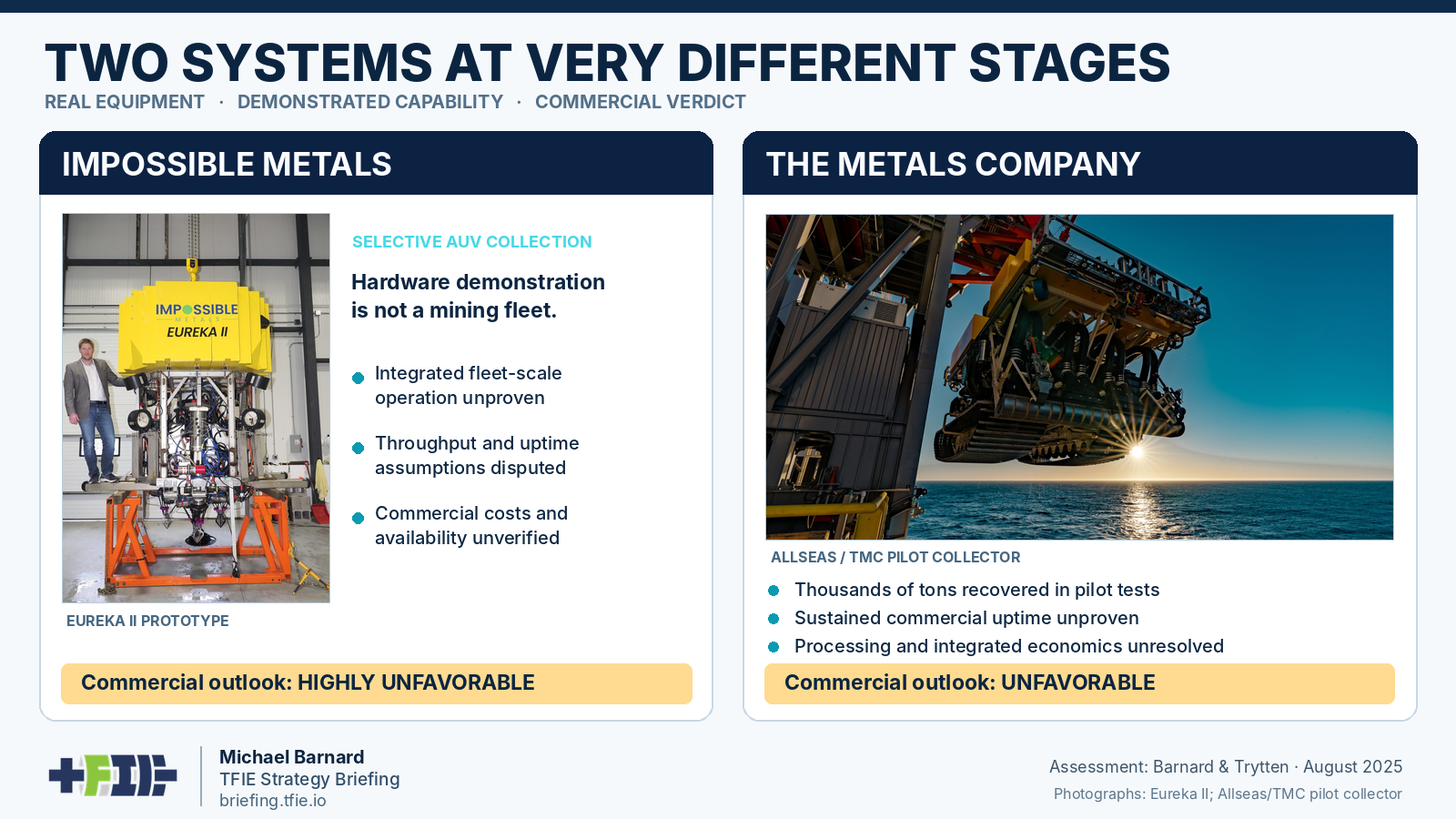
The Metals Company and Impossible Metals are asking us to believe in a future they have not yet built. TMC recovered 3,021 wet tons of nodules in 2022 at 86.4 wet tons per hour during its pilot phase. Now it is discussing one million tons annually, then 12 million tons across four vessels. Impossible Metals conducted a September 2026 scientific trial that recovered approximately 450 grams of nodules from more than 4,000 metres depth. The gap between these pilot achievements and the promised commercial scale is so vast that it demands scrutiny before investment or regulatory approval.
The arithmetic of TMC's ambitions exposes the problem. At 5,000 productive hours annually—about 57% of a calendar year—a system collecting 200 wet tons per hour delivers one million tons. The second-year target of 1.5 million tons requires 300 tons per hour. Three million tons requires 600 tons per hour. TMC's 2022 test rate of 86.4 tons per hour would deliver only 432,000 tons under those conditions. The November 12, 2026 corporate update describes a phased approach that reduces initial capital but pushes the demonstration of projected commercial rates into the future. This is not a path to proof; it is a deferral of accountability.
Impossible Metals' autonomous model faces even steeper challenges. The company proposes vehicles carrying 12 tons of nodules with 18 collection arms, requiring roughly 120,000 successful picks per mission at one nodule every 1.5 seconds per arm. Collection alone consumes approximately 2.8 hours of a proposed four-hour mission cycle. Descent, ascent, searching, repositioning, failed picks, recovery, unloading and relaunch must also fit into that window. An independent techno-economic assessment tested financial effects of weaker productivity: at illustrative $180 per dry ton nodule sales value, halving robot throughput increased required capital from approximately $2.52 billion to approximately $4.51 billion, moving net present value from positive $863 million to negative $769 million at a 10% discount rate.
What both companies lack is the evidence that matters most: sustained operating records demonstrating productive hours, throughput consistency, maintenance costs and delivered cost per ton. TMC's August 2025 prefeasibility estimates offshore collection and transport at $179 per dry ton. These are projections, not audited costs from continuous industrial mining. Capital and offshore operating costs continue whether or not nodules are arriving on deck. Ships, crews and financing bills do not pause during maintenance and interruptions.
Policymakers and investors should demand extended end-to-end offshore operating records and audited unit economics before treating future production targets as investable output. Neither company has demonstrated the productive hours, throughput and maintenance costs needed to support its commercial proposition. The technology risk exists before accounting for nodule processing, metals markets, permitting or environmental liabilities. Seabed mining is not ready for commercial deployment, and the companies involved should prove it rather than ask regulators and investors to assume it.