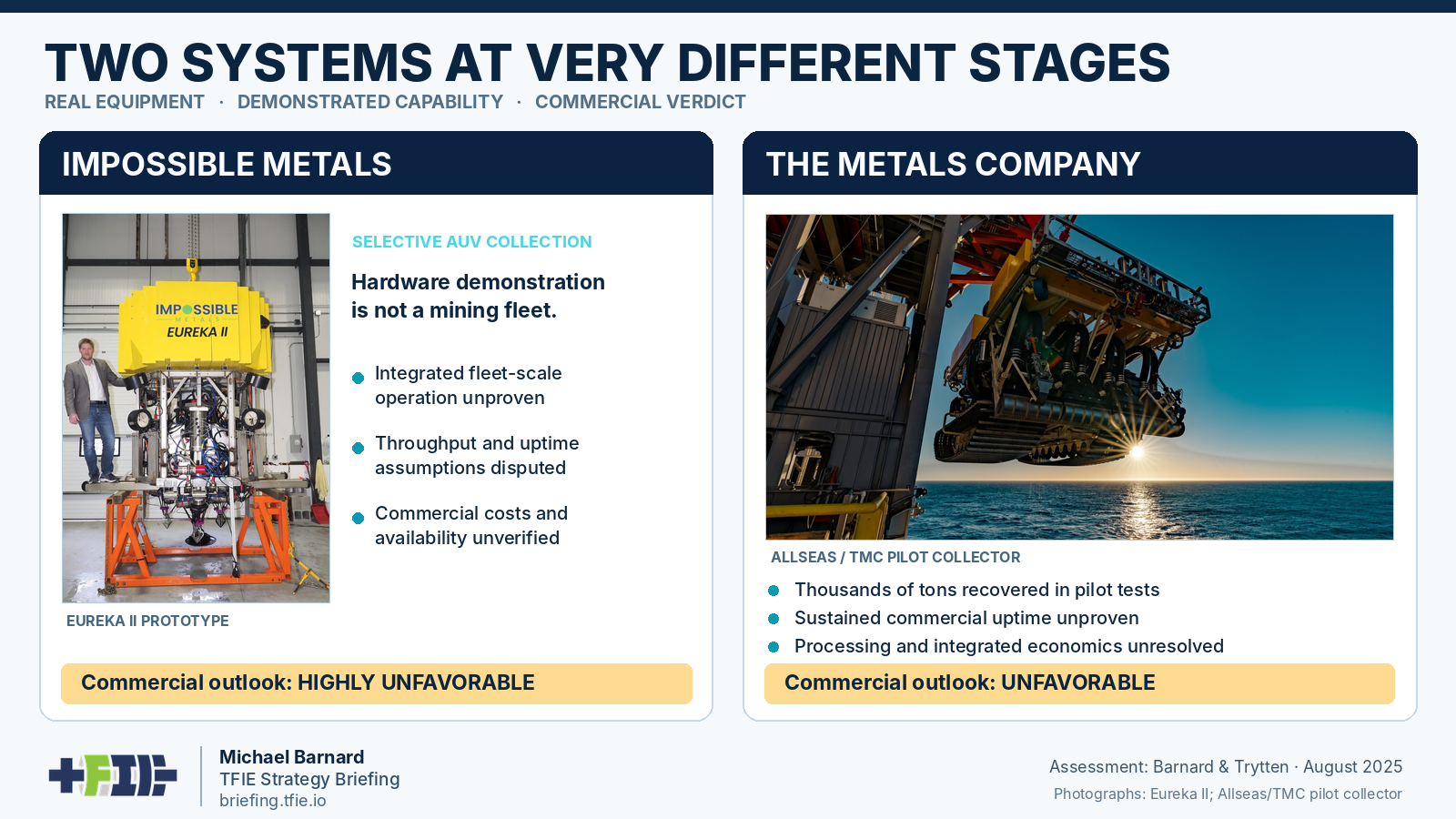
The Metals Company has not closed the gap between its 2022 pilot test and its stated commercial production targets, according to a production analysis. In 2022, the company and contractor Allseas recovered 3,021 wet tons of nodules from the Pacific seabed, with the collector achieving 86.4 wet tons per hour during production runs. TMC now discusses one million tons annually from an upgraded system and eventually 12 million tons per year across four vessels.
The arithmetic reveals the challenge. At 5,000 productive hours annually (about 57% of a calendar year), a system collecting 200 wet tons per hour delivers one million tons. TMC's 2022 rate of 86.4 tons per hour would yield only 432,000 tons under those conditions. The upgraded collectors are expected to perform differently from the 2022 test unit, but their performance must be demonstrated, not assumed.
A production system requires a collector, a multi-kilometre hydraulic riser and a vessel to work together. The crawler encounters uneven ground and varying nodule coverage. The riser handles abrasive slurry. The vessel must remain on station for maintenance and repairs. Offshore access and weather limit when activities can occur. A system producing at its test rate can still lose the year to maintenance and interruptions.
Fixed costs continue whether or not nodules arrive. Ships, crews, marine maintenance equipment and financing cost money during production stoppages. Smaller annual production spreads fixed expenses over fewer tons and raises the cost per ton recovered.
TMC's August 2025 prefeasibility presentation estimated offshore collection and transport at $179 per dry ton. Those projections are for a future system, not an audited cost record from continuous industrial mining.
Impossible Metals proposes autonomous underwater vehicles to collect individual nodules instead of a tracked crawler and riser. Its September 2026 scientific trial recovered approximately 450 grams of nodules from more than 4,000 metres depth. A commercial robot would need to carry vastly more material and sustain cycle times and availability that the experiment did not measure.
An independent 2025 techno-economic assessment tested financial effects of weaker robot productivity. At an illustrative $180 per dry ton nodule sales value, halving throughput while maintaining output increased required capital from approximately $2.52 billion to approximately $4.51 billion. At a 10% discount rate, the net present value moved from positive $863 million to negative $769 million.
Neither company has demonstrated the productive hours, throughput and maintenance costs needed to support its commercial proposition. TMC is further along technologically than Impossible Metals, but its future-scale production economics remain unsupported by a sustained operating record.