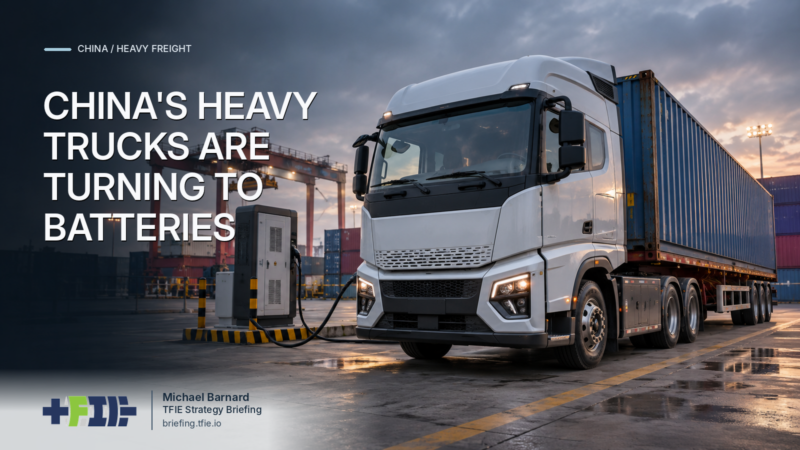
In September 2026, battery-electric trucks captured 49.8% of China's new domestic heavy-truck registrations, with 32,800 of 65,800 trucks sold running on batteries. The share has grown rapidly: battery electric represented about 13% of registrations in 2024, 28% in 2025, and nearly 38% in the first nine months of 2026. From May through September 2026, new-energy heavy trucks exceeded 40% of registrations for five consecutive months.
The shift pressures diesel and liquified natural gas suppliers. Tractor units pulling semi-trailers led the transition, with 64.48% of new domestic tractor registrations in September belonging to the new-energy category. Electric trucks are moving freight on ordinary commercial routes beyond ports and industrial yards.
Operating economics drive the adoption. Fleet operators evaluate annual kilometres, payload, electricity prices, charging stops and vehicle availability alongside purchase price. Three case studies from the International Council on Clean Transportation documented the advantages. A Guangdong warehouse fleet of 28 electric trucks achieved estimated five-year ownership costs 16% below comparable diesel trucks. An express delivery operation in the Yangtze River Delta with 50 electric tractor-trailers working 300–500 km routes achieved a 3% advantage over six years without purchase incentives. Another operation covering 900 km daily with strategically placed high-power charging showed estimated ownership costs 19% below diesel.
Battery swapping has captured part of the market. In September, 20.09% of newly registered battery-electric heavy trucks were swap-capable, down from 30.39% for all of 2025. Conventional charging gained a larger share of the expanding electric market.
China is building infrastructure to support the shift. Yunnan commissioned 3,350 km of heavy-truck charging corridors in 2025 with 113 stations and 869 connectors. Fujian opened a 649 km coastal corridor in October 2026 with 15 charging stations and eight swapping stations. The International Energy Agency's 2026 charging review describes heavy-vehicle charging concentrated around freight corridors and industrial centres.
Hydrogen fuel cells have made little progress. China registered 689 fuel-cell heavy trucks in the first nine months of 2026 compared with more than 223,000 battery-electric trucks. Kpler projects new-energy trucks, predominantly battery electric, will account for about 8% of Chinese heavy trucks in service at the end of 2026 and displace about 230,000 barrels of diesel per day compared with diesel trucks moving the same freight.
China's June 2026 heavy-truck programme set 2030 targets including a 40% share of new-energy heavy-truck sales, a 20% share of the operating fleet and 30,000 km of zero-carbon freight corridors. Monthly new sales have already surpassed the sales-share target, though building and replacing enough vehicles to reach the fleet target will take longer.