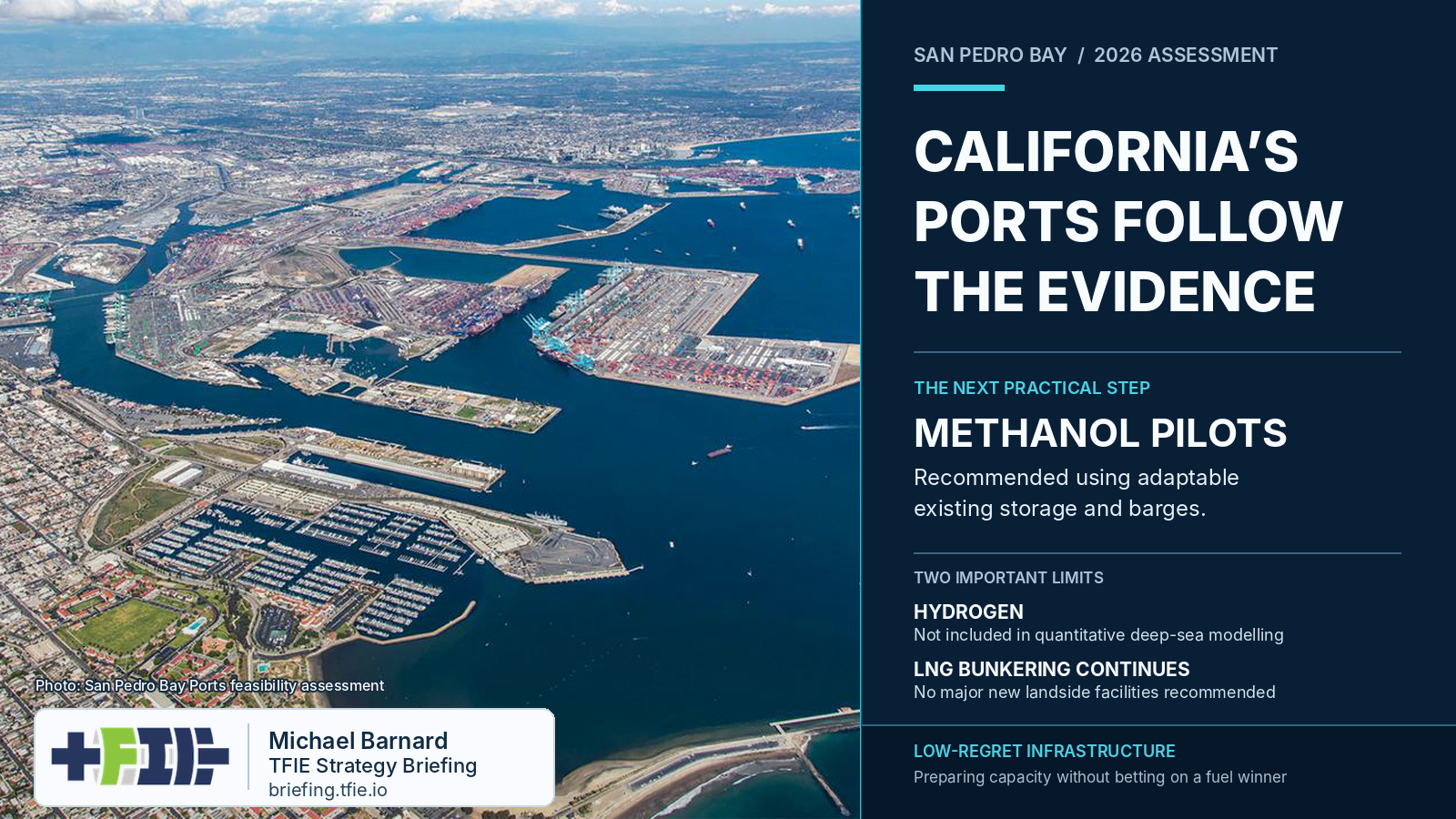
For two decades, California has invested substantially in hydrogen as a transportation solution, subsidizing vehicles, backing refueling networks, and supporting fuel-cell buses and trucks. So the October release of the Clean Marine Fuel Feasibility Assessment by Los Angeles and Long Beach—the two enormous ports anchoring America's Pacific container trade—carries a message that extends far beyond maritime policy. These commercially important institutions have examined shipping fleets, carrier preferences, fuel availability and infrastructure costs, and deliberately left hydrogen out of their detailed deep-sea shipping plans. This isn't ideological rejection; it's a market-based verdict.
The ports' reasoning cuts to a fundamental problem that has plagued California's hydrogen strategy: confusing technical possibility with commercial demand. Fuel-cell passenger cars proved they could operate, yet struggled with expensive fuel, unreliable stations, and battery-electric competition. Hydrogen buses and trucks faced similar obstacles, compounded by the economics of fleet fuel supply. The shipping industry presents even steeper challenges. A container vessel requires immense energy over long voyages. Hydrogen's low volumetric energy density, expensive handling, and demanding onboard storage make the fuel system economically difficult to accommodate. The problem extends beyond the ship to production, transportation, storage, and bunkering equipment.
The evidence is stark: of 38 shipping lines contacted in the ports' survey, 19 responded. Nine expressed varying degrees of interest in methanol, but only one did so for hydrogen. That single interested carrier cannot justify expensive hydrogen infrastructure investment. Meanwhile, methanol—a liquid under ordinary conditions that fits into a mature global chemical-handling industry—offers a more viable path. Long Beach is already offering a $1 million incentive for initial commercial-scale methanol bunkering, testing operational feasibility without enormous permanent facility commitments.
Yet California's ports must not treat methanol as an automatic climate victory. Methanol can be manufactured from natural gas, coal, biomass, or electricity-based pathways with radically different greenhouse gas consequences. The ports can build a technically successful methanol bunkering service without achieving substantial shipping decarbonization if the fuel delivered is fossil-based. Similarly, their accommodation of existing LNG-capable ships without recommending major new shoreside LNG infrastructure reflects fossil LNG's weak climate case when methane leakage and engine slip are included.
The larger significance is simple: California's most important maritime gateways have applied a commercial filter that much of the state's transportation hydrogen strategy has resisted. This doesn't mean hydrogen has no future role in shipping, but it means California must stop treating hydrogen enthusiasm as sufficient justification for infrastructure investment. Existing demand and affordable infrastructure must determine near-term choices. The ports' decision reflects a maturing approach to decarbonization: commercial viability matters alongside environmental ambition.