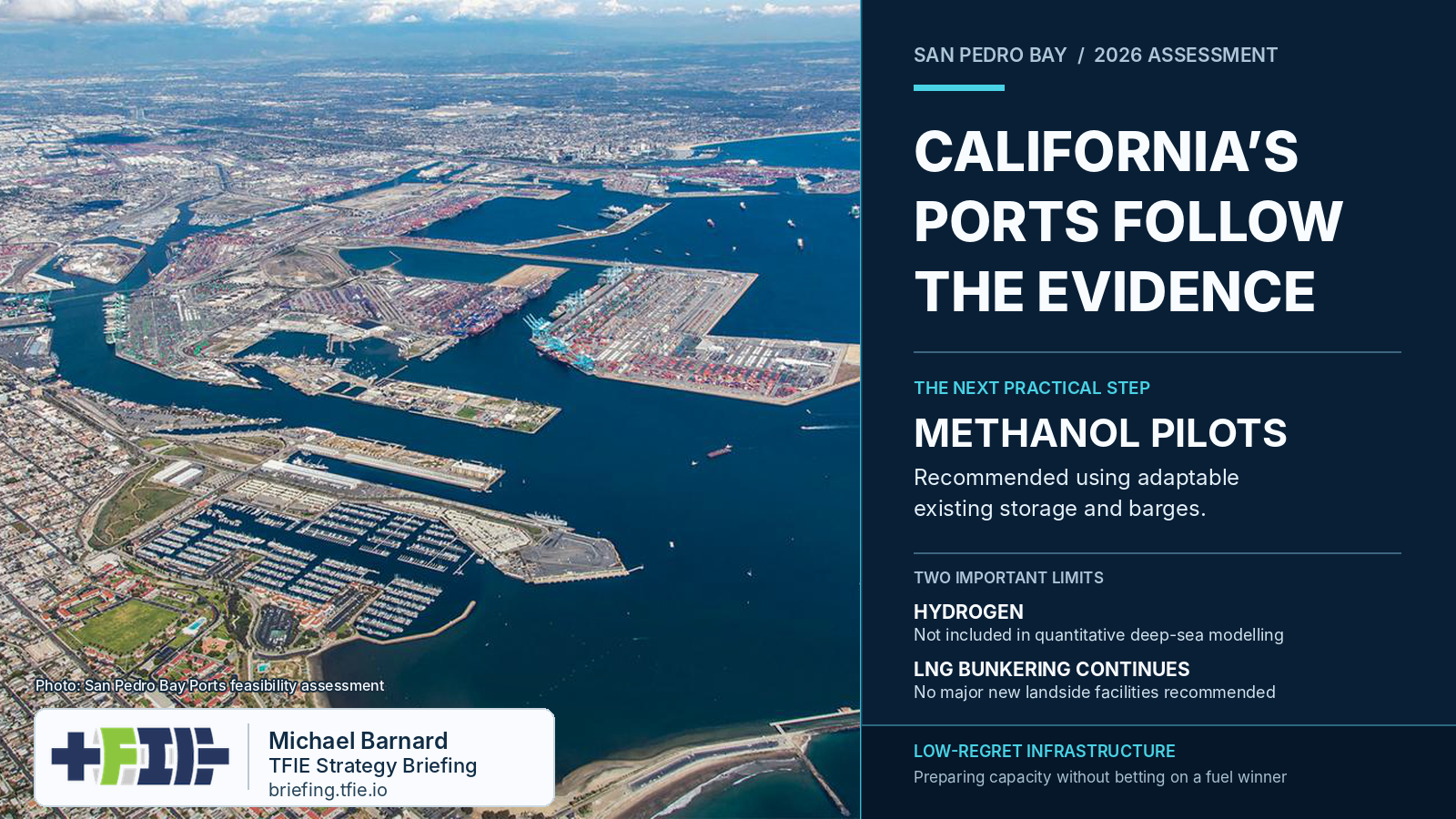
Los Angeles and Long Beach ports released a comprehensive marine fuel assessment in October that excludes hydrogen from detailed deep-sea shipping plans, despite California's two-decade history of subsidizing hydrogen vehicles and infrastructure.
The Clean Marine Fuel Feasibility Assessment examined shipping fleets, carrier preferences, fuel availability and infrastructure costs. The ports recommend developing commercial methanol bunkering demonstrations and continuing existing ship-to-ship liquefied natural gas arrangements. They advise against major new fuel terminals until demand becomes credible.
Of 38 shipping lines contacted in the survey, 19 responded. Nine expressed varying degrees of interest or commitment concerning methanol. Only one expressed interest in hydrogen.
Hydrogen faces particular obstacles in deep-sea shipping. The fuel's low volumetric energy density, expensive handling and demanding onboard storage make the system difficult to accommodate economically. The infrastructure challenges extend to production, transportation, storage and bunkering equipment.
Methanol offers practical advantages. It is a liquid under ordinary conditions and fits into existing global chemical-handling industry infrastructure. Existing storage and bunkering equipment can be adapted rather than requiring entirely new cryogenic or high-pressure networks. Long Beach is offering a $1 million incentive for an initial commercial-scale methanol bunkering operation.
The ports' decision reflects a commercial filter. For years, California's hydrogen ambitions kept the molecule central to transportation discussions. The planning process has produced a different hierarchy based on existing demand and affordable infrastructure.
The author notes that methanol is not inherently a climate solution. It can be manufactured from natural gas, coal, biomass or electricity-based pathways with radically different greenhouse gas consequences. The ports could build a technically successful methanol bunkering service without achieving substantial shipping decarbonization if the fuel delivered is fossil-based.