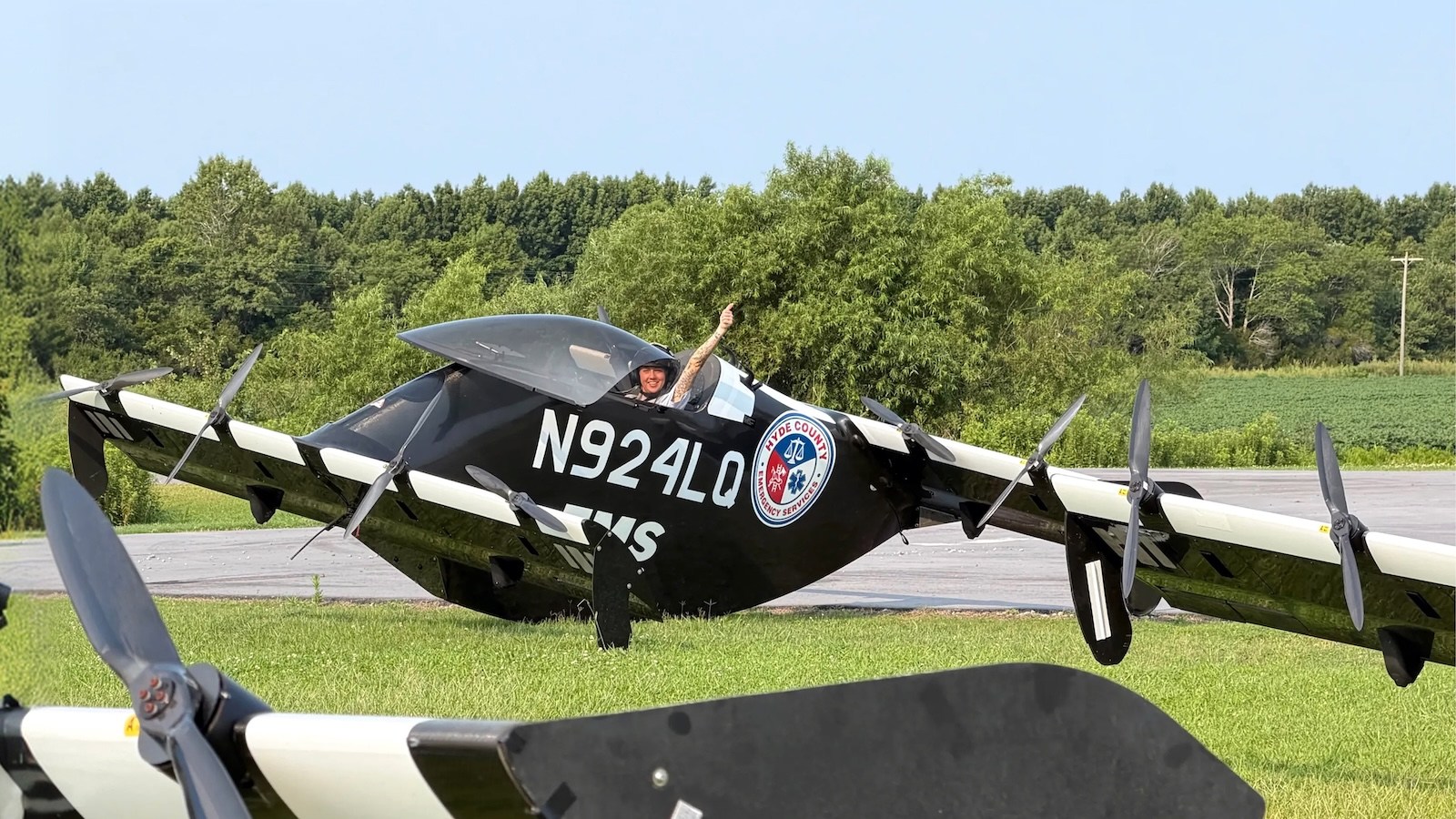
A paramedic in Hyde County, North Carolina flew a single-seat electric aircraft called BlackFly to a 911 call in March, arriving 20 minutes before ground ambulances. The county launched a six-month trial with Pivotal to test whether the aircraft could speed emergency response across its 1,459 square miles of rural land and water.
The BlackFly, about 14 feet long and resembling an oversized drone, travels at about 60 mph and can fly 20 miles on a charge while carrying 200 pounds. Paramedic Quinn Reece used the aircraft after a dispatcher gave an incorrect location, flying overhead to confirm the correct address and then providing patient care before ambulances arrived.
Brook Cox, the county's emergency medical services chief, supervised more than 300 training flights before using the aircraft for actual 911 calls. The FAA considers emergency medical response an important application for electric vertical takeoff and landing aircraft, or eVTOLs, particularly in rural areas where response times average nearly 15 minutes compared to an eight-minute target.
Jump Aero, which has spent seven years developing the JA1 Pulse, sees eVTOLs as adding to emergency response rather than replacing helicopters or ambulances. The JA1 Pulse reaches 288 mph, carries 350 pounds, and has a 70-mile range. Carl Dietrich, Jump Aero's founder, said the aircraft can launch immediately without warming up, important for a field that needs rapid response.
Cost favors the technology. Pivotal's BlackFly sells for $190,000 compared to helicopters at $500,000 to $10 million. Operating costs for electric aircraft may be about 80 percent cheaper than similarly sized fossil fuel machines.
Beyond emergency response, solar-powered stratospheric aircraft are being developed for environmental monitoring. Harvard researcher Craig Mascarenhas said such aircraft could circle areas at 65,000 feet, remaining aloft for weeks to monitor soil and vegetation moisture, spot wildfires, and track hurricanes and methane emissions.
However, Mascarenhas cautioned that the climate case for eVTOLs is unclear when they replace efficient ground transportation. "Vertical flight is inherently energy-intensive, and an electric aircraft is not necessarily more energy-efficient or lower-carbon per passenger-mile than an electric car, bus, or train," he said.