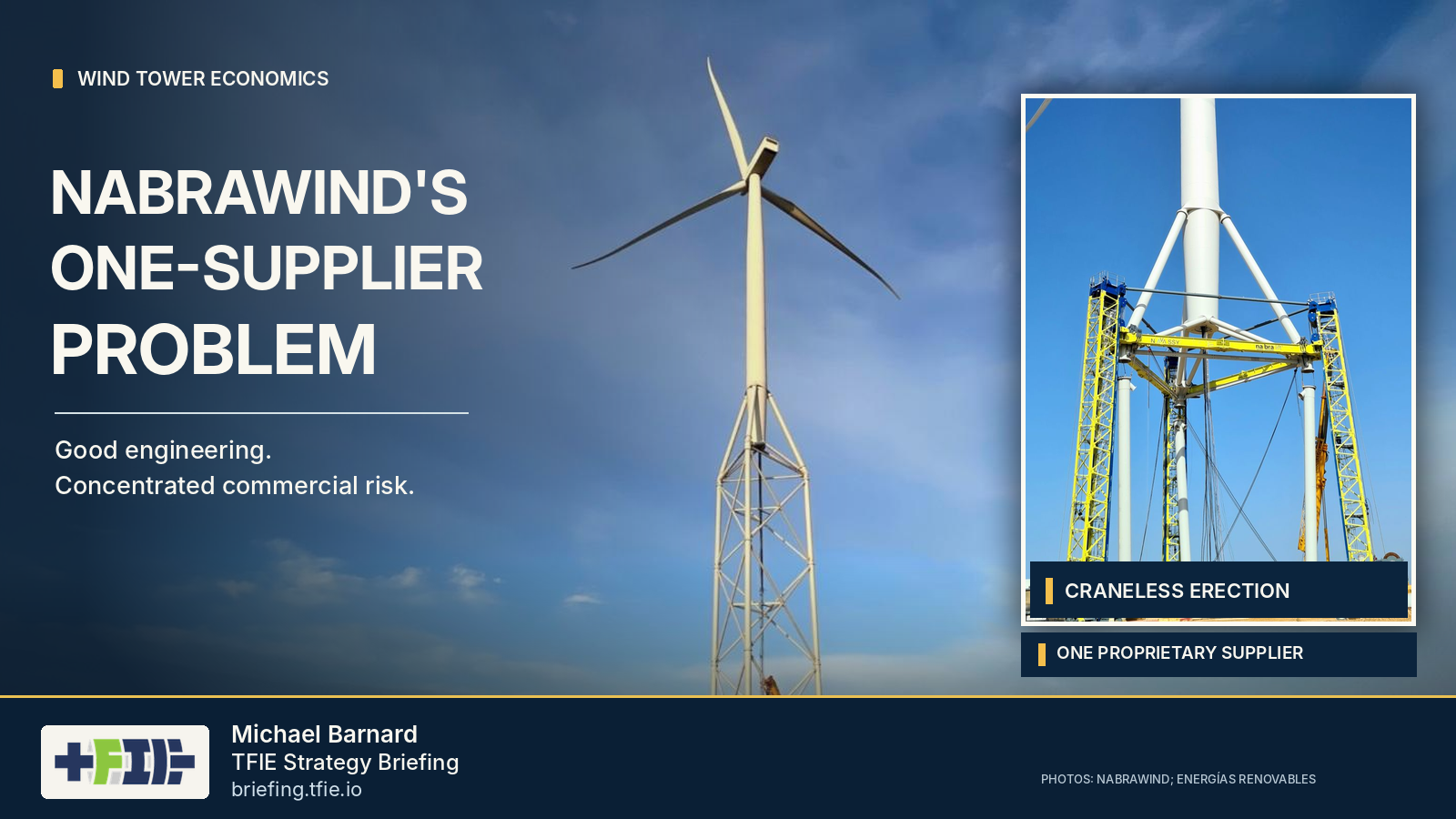
Spain's Nabrawind has developed a wind tower installation system that eliminates the need for large crawler cranes. The Nabralift system uses hydraulic equipment to raise an assembled turbine while modular tower sections insert below it near ground level. A removable lifting frame can then relocate to another site.
UL Solutions issued type certification in September 2026 for Envision's 7.8 MW turbine on Nabrawind's 188-meter tower. Fortescue is installing 17 of these configurations at its 133 MW Nullagine wind project in Western Australia's Pilbara region, with construction underway.
Nabrawind reports using roughly 20% less tower steel than comparable conventional designs and reducing foundation concrete by as much as 80%, though these are supplier claims rather than independently verified figures across multiple wind farms. The system could reduce total installed cost and construction schedules by avoiding large cranes, simplifying transport and enabling turbine raises in windier conditions.
Fortescue acquired Nabrawind in September 2025 and is building Nullagine to power its own mining operations. While successful installation would demonstrate construction performance, it would not prove that an unrelated wind developer could finance and maintain the system under standard commercial terms.
Nabrawind's proprietary approach creates a procurement challenge. Conventional towers can be sourced from multiple manufacturers, but Nabralift currently depends on one supplier for the tower system, lifting expertise and support. Developers would need enforceable delivery schedules, long-term warranties, repair and maintenance provisions, spare parts clarity and remedies if the supplier's capacity changes. These concerns intensify over a wind farm's 25-year or longer operating life with no qualified alternative provider.
Nabrawind's broader market adoption depends on an independently developed and financed large wind farm accepting these supplier risks on commercial terms. Greater installation partnerships, credible long-term service arrangements and competitive capacity would make the engineering advantages more accessible to developers.