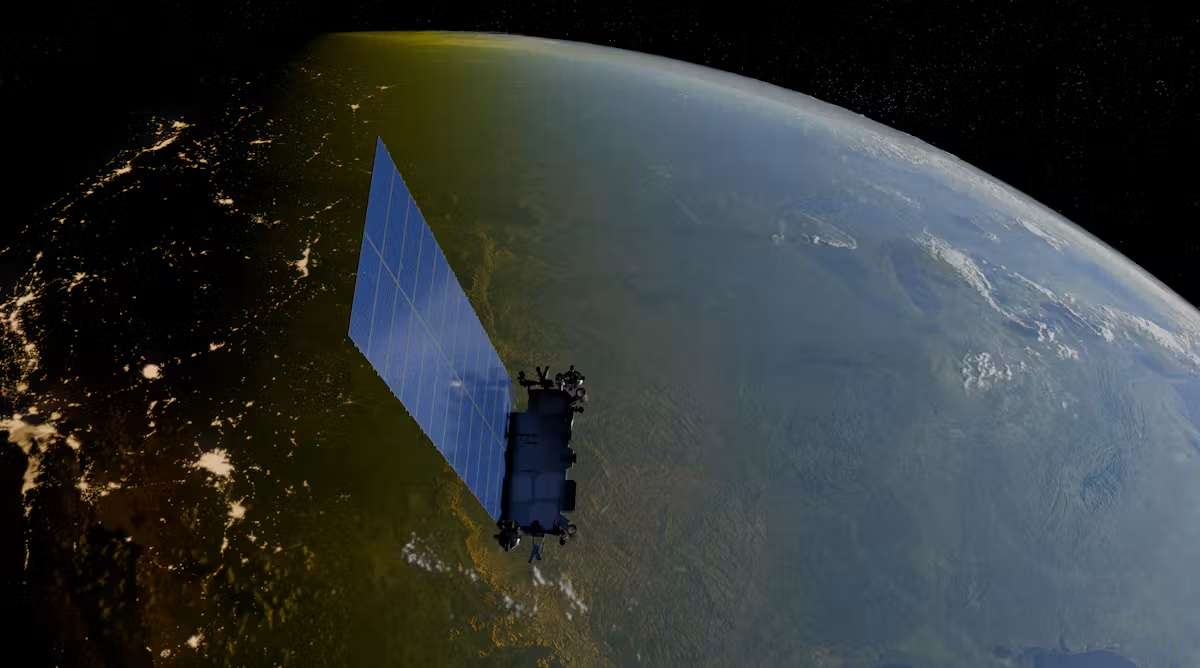
Radio noise leaking from satellites is degrading measurements from radio telescopes and corrupting GPS positioning data, according to research conducted in Australia.
A team using a radio telescope in Western Australia measured radio energy emitted from Starlink satellites at frequencies between 70 and 300 megahertz. The emissions exceeded limits set by the International Telecommunication Union between 50% and 70% of the time. International guidelines permit exceedances for up to 2% of measurements.
A separate CSIRO-led team used telescopes in New South Wales operating at frequencies from 1 gigahertz to 14 gigahertz. The team measured licensed signals, harmonics, and electrical hum from onboard electronics. They modeled the effect of 12,000 satellites on Australian telescopes used for geodesy, which measures Earth's rotation by precisely localizing distant galaxies to link celestial and terrestrial reference frames.
With current satellite numbers, direct-to-phone satellites already spoil over half, 59%, of the geodetic measurements behind GPS. When modeled to 300,000 satellites, a small fraction of what is planned, every geodetic measurement is lost.
Radio telescopes detect exceptionally weak cosmic radio waves from the early universe and distant galaxies. They are protected from powerful radio signals by being built in quiet locations. Satellite operators already shield electronics to prevent unintended radio energy from interfering with launch rockets, but leakage occurs once satellites are operational in space.
The International Telecommunication Union's Radiocommunication Sector sets regulations for radio spectrum use based on simulations of intended satellite transmissions. The regulations do not factor in unintended radio energy. National regulators enforce the rules for ground transmitters, but no telescope regulator has jurisdiction over foreign satellites.
To address the problem, satellite operators need to shield electronics over wider radio frequency ranges and lower the amount of radio energy that leaks. An important first step is implementing a system that routinely monitors radio interference from satellites to inform policy decisions and standards work.