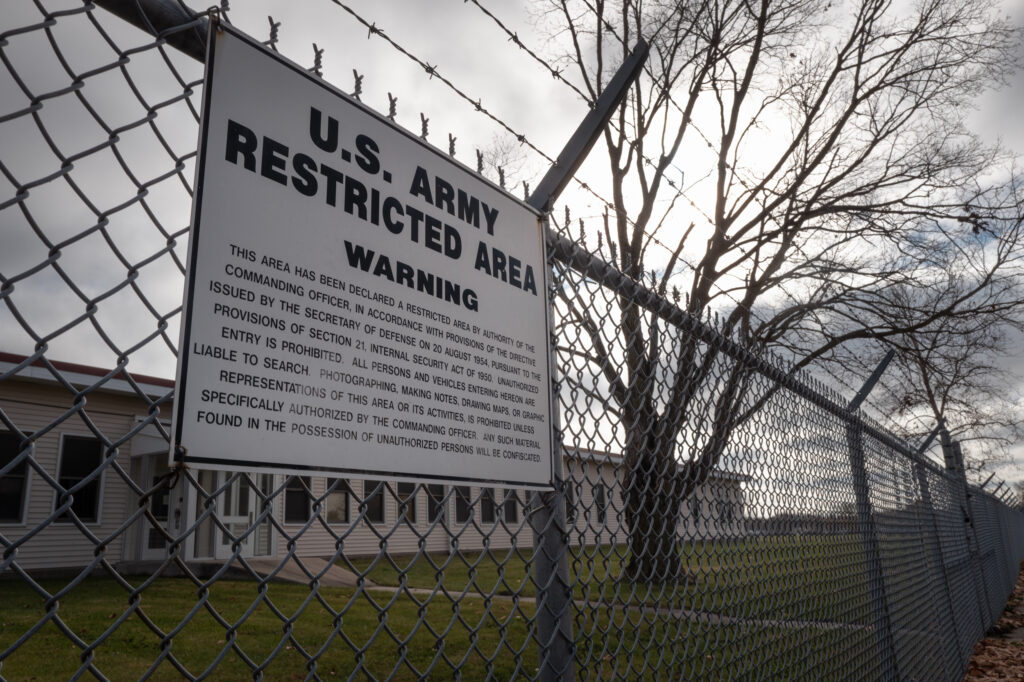
The U.S. Army plans to detonate nearly five tons of lead azide explosives stored in bunkers at the Iowa Army Ammunition Plant in Middletown on Wednesday. A federal court lifted an administrative stay on Monday, clearing the path for the operation after petitioners sued the Environmental Protection Agency over its emergency permit.
Lead azide, a material used to make bombs, has degraded into irregularly shaped crystals that the Army says have become highly sensitive to friction and shock after decades of storage. The Army contends that freezing temperatures will destabilize the crystals further and the barrels must be disposed of before winter.
The Army had planned the detonation for last Friday, but postponed after a court granted an administrative stay requested by the Iowa Environmental Council and Sierra Club Iowa Chapter. On Monday, the court rejected the petitioners' request for a longer block on the operation.
Army maps released for the original Friday detonation show a lead dust cloud spreading across potentially hundreds of miles of Eastern Iowa, with projected concentrations exceeding federal benchmarks for lead levels in homes and childcare facilities. The EPA advises there is no safe level of lead exposure for children.
The Justice Department argues in court filings that an emergency provision in the Resource Conservation and Recovery Act of 1976 allows the Army to proceed without a permit if explosive materials present an "immediate threat to human health, public safety, property, or the environment." A Justice Department brief states that "a controlled detonation is the only way to minimize the release" compared to alternatives requiring opening or moving the barrels, which the Army says risks unintentional detonation.
President Donald Trump posted Monday on Truth Social that he ordered the military not to proceed until both the appeals court and Governor-elect Rob Sand agree to it. Trump blamed the Obama administration for improper storage and said Sand, a Democrat taking office Jan. 12, would be held responsible for any catastrophic explosion from delays.
Current Iowa Gov. Kim Reynolds, a Republican, has activated the State Emergency Operations Center in preparation. Middletown Mayor Rodney Johnson said in a video released this weekend that further delays increase catastrophic risk. "Each day that the disposal is delayed is another day that could increase the risk of major catastrophe."
The Army has not disclosed the specific time of Wednesday's detonation nor released updated plume maps. Southwest winds are forecast for Wednesday, potentially shifting the lead dust path significantly from early projections based on northern winds.
Under the EPA emergency permit, the Army must provide five days' public notice and regularly updated plume maps. But if the Army bypasses the permitting process as it has indicated, it remains unclear which provisions it plans to follow.