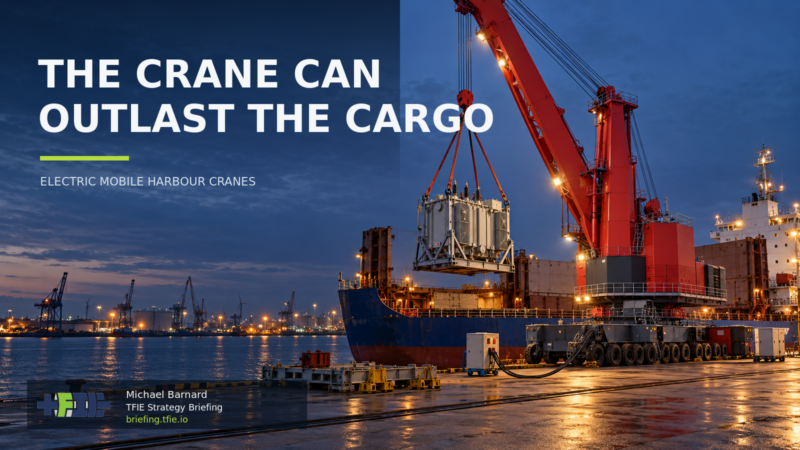
Katoen Natie's decision to deploy six electric mobile harbour cranes at the Port of Antwerp—two already in service as of October, with four more coming across three deep-sea multipurpose terminals—deserves attention for reasons that extend far beyond the impressive 500,000 litres of diesel these machines will displace annually. This investment demonstrates something ports desperately need: equipment that remains valuable regardless of which cargo becomes tomorrow's mainstream business.
The engineering challenge solved here is real. Fixed container cranes stay put and connect to stable electrical supplies, making them straightforward candidates for electrification. Mobile harbour cranes travel along quays, move between assignments, and handle wildly varied cargo—steel, wind components, transformers, scrap, containers. Historically, this demanded onboard diesel generators. Konecranes' solution splits the problem: grid electricity powers the heavy lifting work, while rechargeable batteries enable movement between positions. This elegance matters because it eliminates diesel exhaust and local noise without forcing cranes to carry enormous batteries for work that doesn't require them.
But the real value extends beyond environmental gains. A 200-tonne or 150-tonne crane capable of lifting a transformer today can handle construction machinery or industrial equipment tomorrow. This flexibility addresses a crisis ports face that few outside the industry fully grasp: fossil-fuel cargoes—coal, oil, and gas—that financed major berth, terminal, and channel investments are entering long-term decline. Ports cannot replace that cargo tonne for tonne with low-carbon alternatives, and they certainly cannot all capture equivalent growth in container traffic. The commercial risks are severe for terminals built around individual commodities.
Ports pursuing containers, renewable-energy equipment, industrial products, and alternative fuels need equipment investments that survive multiple plausible freight futures. Electric mobile cranes fit that requirement precisely because their utility spans cargo types and their electrical supply can integrate with wider yard electrification—supporting trucks, shore power, and harbour craft alongside the cranes themselves. A terminal still must demonstrate sufficient durable activity, adequate electrical infrastructure, and a sound operating case. But flexible electric equipment is far less dependent on correctly predicting which replacement cargo wins than building another dedicated facility tailored to fossil fuels or a single alternative fuel.
Katoen Natie's six cranes—with their paired 400-tonne lifting capacity—show what prudent port investment looks like during the energy transition. These machines reduce diesel consumption today while preserving commercial optionality tomorrow. Other ports should study whether similar investments suit their circumstances, because this is how infrastructure strategy survives uncertainty: invest in equipment that works across multiple scenarios rather than betting everything on a single outcome.