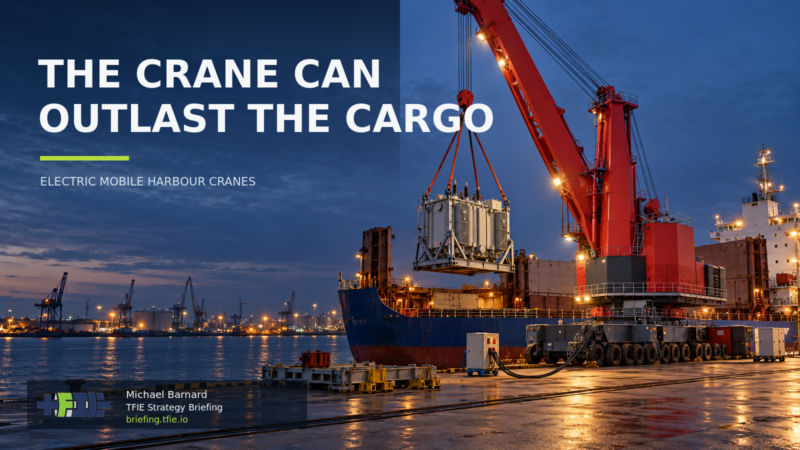
Katoen Natie deployed two all-electric mobile harbour cranes at the Port of Antwerp in October, with four additional cranes planned across three deep-sea multipurpose terminals. The completed fleet will consist of four 200-tonne cranes and two 150-tonne machines, offering paired lifting capacity of 400 tonnes. The company expects the six cranes to displace approximately 500,000 litres of diesel annually once fully operational.
Mobile harbour cranes present different electrification challenges than fixed container cranes. Fixed cranes remain stationary, follow repetitive patterns and connect to substantial electrical supplies. Mobile cranes travel along quays, move between assignments and handle varying cargo types. Historically, onboard diesel generators provided the mobility needed without requiring electrical connections at every potential work location.
Konecranes designed these cranes by separating lifting energy from travel energy. External grid electricity powers heavy lifting work, while rechargeable batteries enable the cranes to move between positions. This approach avoids the need for enormous onboard batteries and eliminates diesel exhaust and noise at the equipment.
The design offers operational flexibility. A mobile harbour crane can handle steel, industrial equipment, transformers, wind components, scrap, project cargo, bulk and containers. Port operators can adjust handling arrangements as customers and cargo flows change without replacing the lifting machinery.
This flexibility matters as the energy transition reshapes maritime trade. Ports face rising capital requirements as fossil-fuel cargoes decline. Coal, oil and gas have traditionally supported major investments in berths, terminals and inland connections. Their reduced role creates commercial risks for infrastructure designed around specific commodities.
Port operators increasingly seek business in containers, renewable-energy equipment, industrial products and alternative fuels. Equipment investments must perform under multiple plausible freight forecasts. Electric mobile cranes support that flexibility. A machine lifting a transformer today can handle scrap steel or construction machinery tomorrow. Electrical supply can also support broader investments in yard equipment, trucks, shore power and harbour craft.