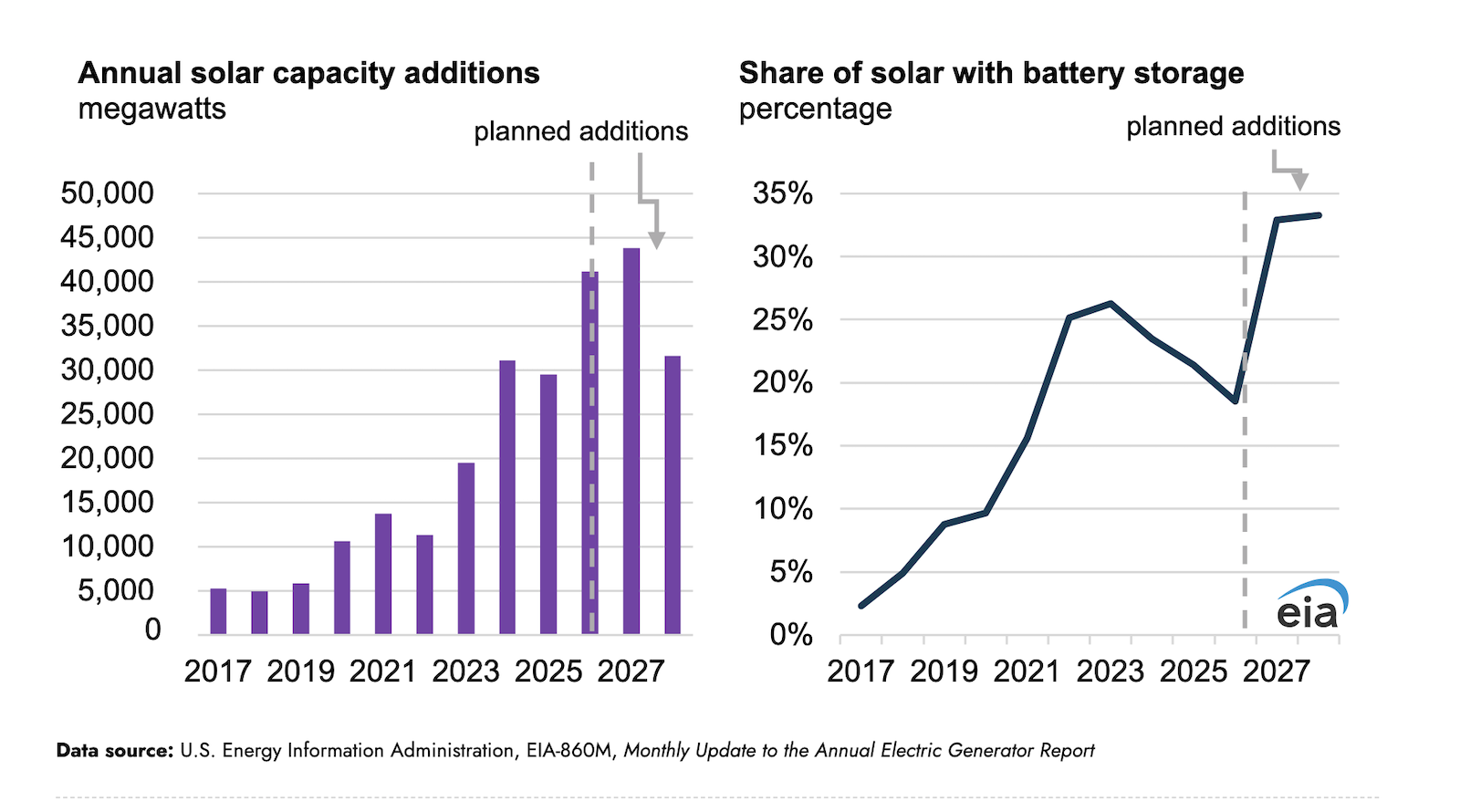
Utility-scale solar developers are increasingly pairing new solar capacity with battery storage. As of September 2026, over 16% of new utility-scale solar capacity added this year includes co-located operable battery storage, up from 2% in 2017, according to data reported to the U.S. Energy Information Administration (EIA) by operators.
Reported plans show the share could reach 19% by the end of 2026. Longer-term projections indicate this will accelerate, with co-located storage reaching more than 30% of planned solar additions for 2027 and 2028.
When solar and battery storage operate at the same site, operators can direct solar output either to the grid or to the battery depending on wholesale electricity prices. Solar-heavy regions experience price drops when solar generation peaks and price increases when it falls. Plants combining both technologies can manage their combined output to maximize revenue as wholesale prices shift.
The EIA tracks these developments through its monthly EIA-860M data collection program, which identifies co-located solar and battery units even when they enter service at different times.
Southwest states show above-average solar capacity and higher levels of co-located utility-scale solar and battery capacity. As of September, solar photovoltaic represents 13% of total U.S. utility-scale generating capacity, with 18% of that solar capacity co-located with battery storage. California, Arizona, New Mexico, and Nevada each have co-located solar and battery shares more than double the national average.