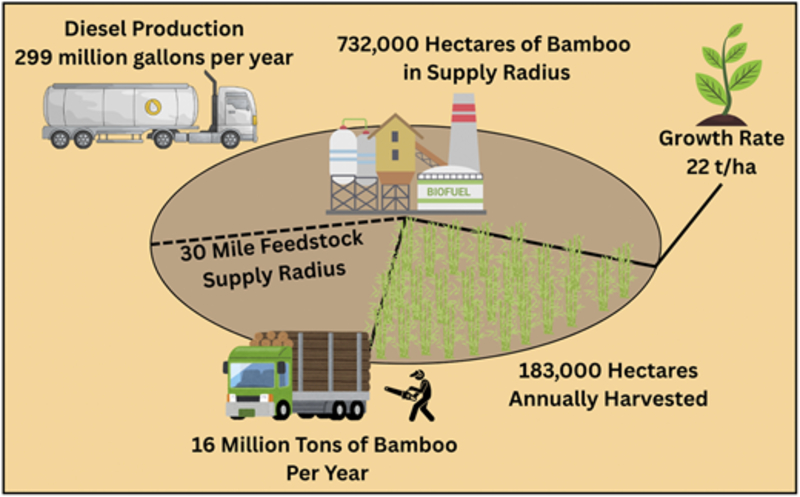
Researchers at Worcester Polytechnic Institute published a study on September 24, 2026, in the Royal Society of Chemistry journal Sustainable Energy And Fuels, proposing bamboo as a feedstock for biofuel production.
Michael Timko, head of chemical engineering at WPI, and Timothy Woodard led the research. They claim bamboo offers advantages over existing biofuel sources. Bamboo species reach full height within months and mature within four years. The plant has low ash content, less than 1 percent by dry weight, compared to 4.8 to 7.3 percent for corn stover and 2.2 to 11.9 percent for switchgrass.
The researchers' economic modeling indicates bamboo-based fuel could sell for $2.75 per gasoline equivalent under mature commercial-scale conditions. When compared to diesel, the resulting emissions are up to 26 times lower. Bamboo's growth rate reaches 22 to 44 tons per hectare per year, at least three times that of corn stover and at least twice that of switchgrass.
Bamboo can grow on marginal or degraded land, reducing competition with food crops. The US could produce as much fuel from bamboo as it makes from corn ethanol while using only 13 percent as much land, according to the study.
The researchers report that bamboo-based fuel would generate a greenhouse gas intensity of 3.5 grams of carbon dioxide-equivalent per megajoule of energy. Timko said in a statement, "Bamboo would use different land than we are using for food production, so there is no food versus fuel trade-off."
The research was funded in part by Pacific Northwest National Laboratory and the National Science Foundation.