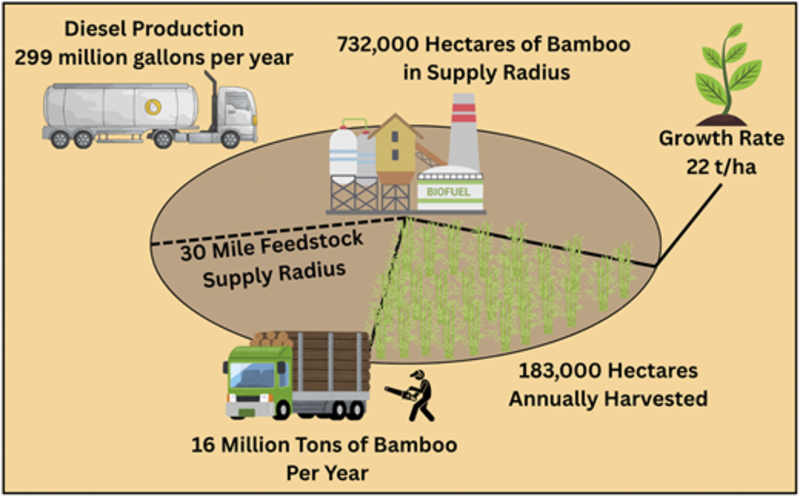
Researchers at Worcester Polytechnic Institute have published findings that should excite anyone serious about decarbonization. According to a study by Michael Timko and Timothy Woodard published September 24, 2026 in the Royal Society of Chemistry journal Sustainable Energy And Fuels, bamboo-based biofuel could be commercially viable at $2.75 per gallon—less than current gasoline prices and half the cost of diesel. When compared to diesel, the resulting emissions are up to 26 times lower. This is not theoretical pie-in-the-sky; this is an economically competitive solution to a transportation crisis.
The advantage over current biofuel schemes is striking. Unlike corn ethanol, which requires enormous energy inputs and produces only modest emission reductions while decreasing fuel economy, bamboo offers genuine environmental benefits. Bamboo is a perennial grass that grows at extraordinary rates—some species reach full height within months and mature within four years. Its ash content is less than 1 percent by dry weight, compared with 4.8–7.3 percent for corn stover and 2.2–11.9 percent for switch grass. This low ash content means the conversion process generates negligible waste and improves conversion efficiency dramatically.
Professor Timko emphasizes a critical advantage: there is no food versus fuel trade-off. The US could produce as much fuel from bamboo as it currently makes from corn ethanol while using only 13 percent as much land. Bamboo can be grown on marginal or degraded land, on former industrial sites where other crops struggle. This means freed-up farmland could return to food production. The researchers found bamboo growth rates of 22–44 tons per hectare per year—at least three times that of corn stover and at least twice that of switch grass.
The carbon storage capacity is equally impressive. Bamboo captures and stores large amounts of carbon both above and below ground through its rhizomes. The research indicates greenhouse gas intensity of just 3.5 grams of carbon dioxide-equivalent per megajoule of energy. For sectors difficult to electrify—heavy-duty transport and aviation—this matters enormously.
Yet here we are with a genuinely promising technology, one funded by the Pacific Northwest National Laboratory and the National Science Foundation, and the smart money says it will be strangled in its crib. We've seen this story before: corn ethanol was protected for decades despite minimal environmental benefit because farmers represent political power. Bamboo threatens both the oil industry and Big Ag's corn empire. Expect heavy taxation, regulatory obstacles, and political resistance designed to protect fossil fuel profits and agricultural incumbents.
The research is sound. The economics work. The environmental case is overwhelming. Whether bamboo fuel actually reaches commercial scale depends entirely on whether we allow innovation to threaten entrenched interests. That's not a scientific question anymore—it's a political one.