China has shifted its regulatory approach to second-life electric vehicle batteries after early promotions of the practice in the 2010s. By the end of 2025, China deployed 551,400 new-energy urban buses, representing 87.5% of its fleet. This early adoption created a large population of retired batteries requiring disposition decisions.
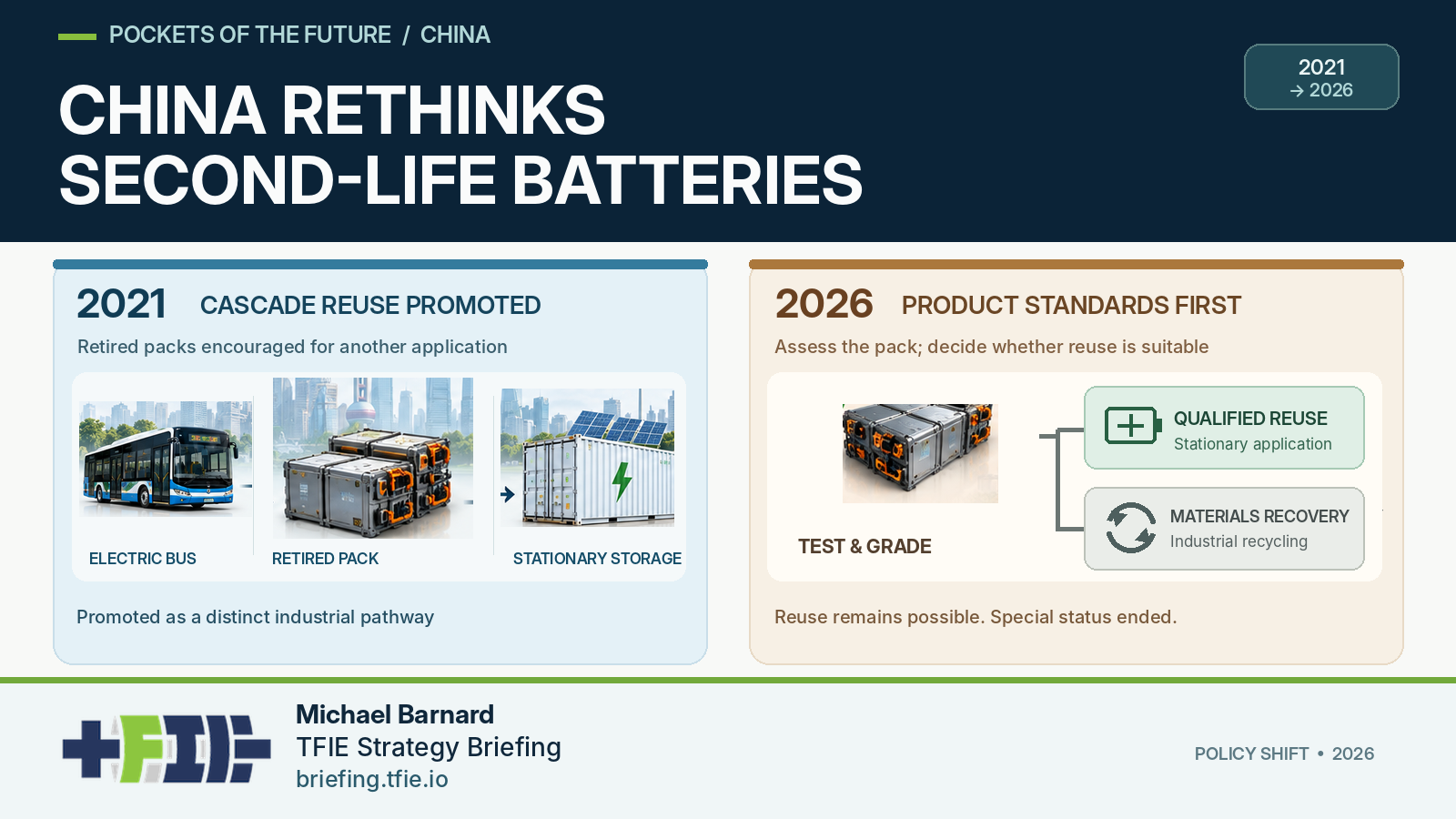
In 2021, Chinese policy encouraged companies to repurpose retired EV batteries in stationary energy storage, backup power, and charging infrastructure. The Ministry of Industry and Information Technology withdrew that special recognition framework in a July 30 announcement. New rules effective April 2026 repealed the earlier cascade-utilization framework. The ministry directed industry associations to stop promotional activities for cascade-utilization companies.
The ministry stated its concern centers on safety risks from inadequately tested, reassembled batteries with varying remaining capacity and inconsistent cell condition. Retired vehicle batteries can still be used in suitable applications when products meet applicable standards. Reuse in electric bicycles and other restricted applications is prohibited.
The economic conditions underlying second-life reuse have changed. Lithium iron phosphate batteries have become much cheaper. Testing, repackaging, controls and warranties for second-life installations can consume the savings from reusing cells. A second-life installation must compete with new products designed for the same application.
Operators with known battery histories and suitable stationary applications may find reuse economically viable. Product quality and economics will determine how much of the anticipated second-life market develops.