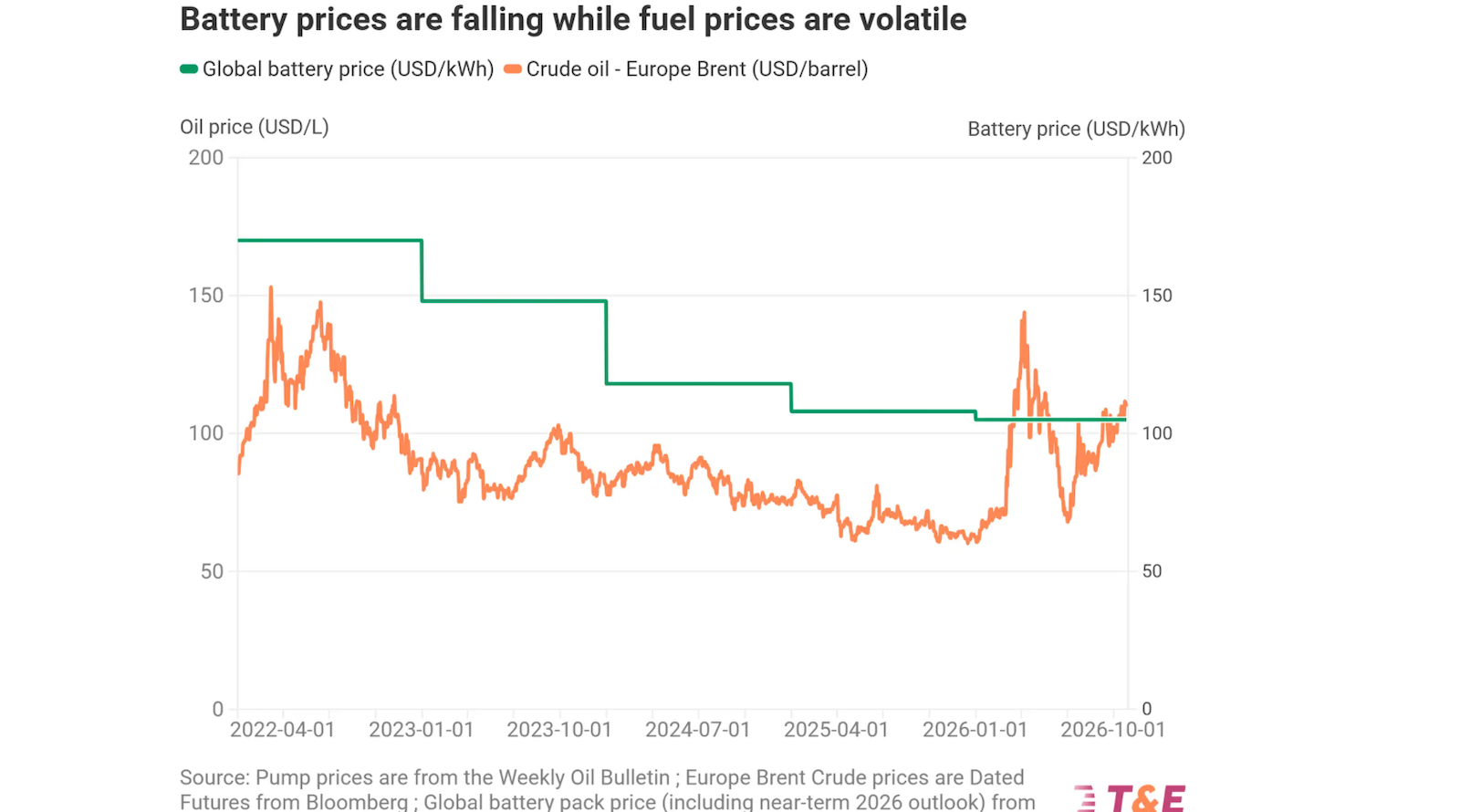
Europe's automotive industry stands at an inflection point. Battery costs have fallen so dramatically that electric vehicle energy now undercuts fossil fuels on pure economics. One kilowatt-hour of battery capacity now costs less than a barrel of oil, a crossover that reshapes the calculus of the continent's industrial future.
The European Union is revisiting its automotive transition strategy with stakes that extend far beyond passenger cars. Brussels must decide how aggressively to enforce its internal combustion engine phase-out and whether to adjust timelines that currently target 2035 for ending new petrol and diesel sales. This debate echoes an earlier one from 2022, but the landscape has shifted. Then, energy prices spiked and supply chains wobbled. Now, battery production capacity is scaling across Europe and Asia, and the fundamental price advantage has tipped decisively toward electrification.
The core tension pits automakers against environmental regulators. Legacy manufacturers invested billions in combustion engine retooling and worry about stranded assets if the transition accelerates. Volkswagen, BMW, Mercedes-Benz, and others argue for flexibility in the timeline, though many have simultaneously announced aggressive EV rollouts. German industry groups have lobbied for extended grace periods or hybrid exemptions that would allow internal combustion vehicles to remain competitive longer.
Environmental advocates counter that delay locks in unnecessary emissions. The EU's transport sector accounts for roughly 27 percent of the bloc's greenhouse gas emissions, with road vehicles responsible for nearly three-quarters of that. Every year the transition slows, the sector misses cumulative emissions reductions needed to meet 2030 and 2050 climate targets. The European Commission and Parliament have grown less sympathetic to industry pleas, particularly after fossil fuel price shocks demonstrated the geopolitical risks of oil dependence.
Battery economics now drive the outcome more than policy preference. A 60 kWh battery pack, typical for a mid-range EV, costs roughly $7,000 to $9,000 in 2024. That same energy stored as gasoline runs $60 to $80 per barrel at current prices. The cost per unit of energy stored favors batteries by an order of magnitude, and that gap widens as manufacturing scales. European battery gigafactories under construction in Poland, Hungary, and Germany will add 300 GWh of annual capacity by 2030, enough to supply several million vehicles yearly.
The debate also encompasses supply chain resilience. Europe depends entirely on imported lithium, cobalt, and nickel. Securing these minerals through trade agreements with Australia, Chile, and the Democratic Republic of Congo frames the EV transition as a strategic industrial move, not merely an environmental one. Brussels views battery manufacturing on European soil as essential to reducing Chinese dominance in the sector.
Consumer adoption pressures converge with these forces. EV sales in Europe reached 14 percent of total new car registrations in 2023 and continue climbing. As charging infrastructure expands and model variety increases, price parity with combustion vehicles approaches within two to three years for many segments. At that point, regulatory mandates matter less. Markets shift independently.
The outcome will determine whether European automakers capture growing EV market share or cede it to Tesla, BYD, and Chinese competitors. Delayed transitions risk competitive obsolescence. Accelerated timelines enable first-mover advantage in battery production and supply chains. Brussels recognizes this stakes calculus and is unlikely to weaken 2035 targets substantially.