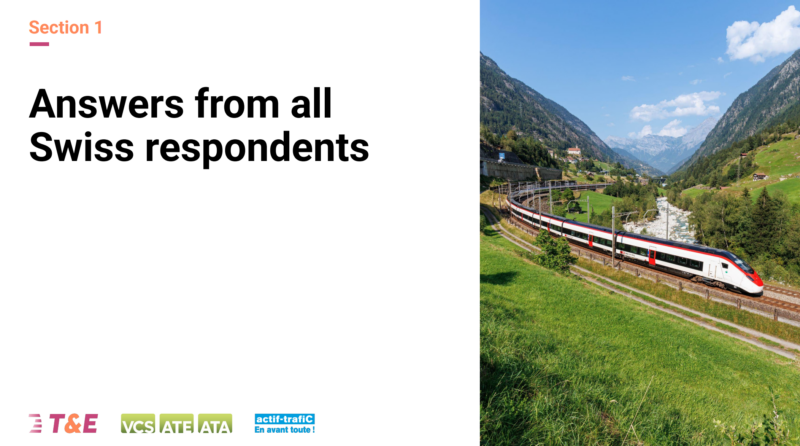
# Swiss Rail Study Shows Strong Demand for UK High-Speed Connections
A new polling study from Switzerland reveals substantial public appetite for direct high-speed rail service connecting Switzerland to the United Kingdom, with nearly half of Swiss adults using international rail at least annually.
The survey, conducted between September 11 and 24, 2026, sampled 1,048 Swiss adults. Results indicate that Swiss travelers view rail as a viable mode for cross-border journeys. The data suggests market demand exists for expanded rail infrastructure linking Switzerland directly to British destinations.
This polling arrives amid broader European discussions about rail connectivity and modal shift away from aviation. High-speed rail networks reduce transportation emissions compared to air travel. A passenger traveling by rail from Switzerland to the UK produces roughly one-tenth the carbon dioxide of an equivalent flight.
The proposed service would represent Switzerland's first direct high-speed rail connection to the UK. Current routes require passengers to transfer through intermediary hubs in France, Germany, or the Netherlands. Eliminating these transfers shortens journey times and removes logistical friction that deters rail use.
Switzerland already operates extensive high-speed networks within Europe. The Swiss Federal Railways (SBB) manages routes reaching speeds of 200 kilometers per hour across the country. The SBB has historically prioritized rail expansion as a climate mitigation strategy. Switzerland achieved 90 percent electrification of its rail network by 2022, among the highest rates globally.
Connecting Switzerland to the UK via high-speed rail requires international coordination. The UK operates the High Speed 1 rail line connecting London to the Channel Tunnel. Infrastructure modifications on both sides of the Channel would be necessary. France would need to agree to routing across its territory, as Switzerland borders France to the west.
Cost represents a barrier. High-speed rail infrastructure investment typically runs 10 to 15 million euros per kilometer. A direct Switzerland-to-UK route spanning approximately 1,000 kilometers would require infrastructure spending exceeding 10 billion euros. Funding mechanisms through EU transport programs, national governments, and private operators would need coordination.
The polling data reflects broader European modal preferences. Studies across Europe show roughly 40 to 50 percent of adults favor rail for international travel when services offer comparable speed and price to air travel. The Swiss result aligns with this continental pattern.
Environmental policy in Switzerland supports rail expansion. The country committed to net-zero greenhouse gas emissions by 2050 under its climate law passed in 2023. Transport contributes approximately 30 percent of Switzerland's emissions. Rail electrification and modal shift from aviation reduce this sector's footprint.
The UK faces similar decarbonization targets. Its 2050 net-zero commitment requires transport emissions cuts of roughly 75 percent from 1990 levels by 2050. High-speed rail expansion serves this objective.
Political obstacles remain. Brexit complicated UK-EU transport coordination. The UK left the EU's Fourth Railway Package framework, which harmonizes rail technical standards. Bilateral negotiations between UK and Swiss authorities would need to establish new technical compatibility standards.
The polling suggests demand exists among travelers. Whether governments, rail operators, and international bodies pursue infrastructure development depends on securing funding and resolving regulatory barriers across three countries.