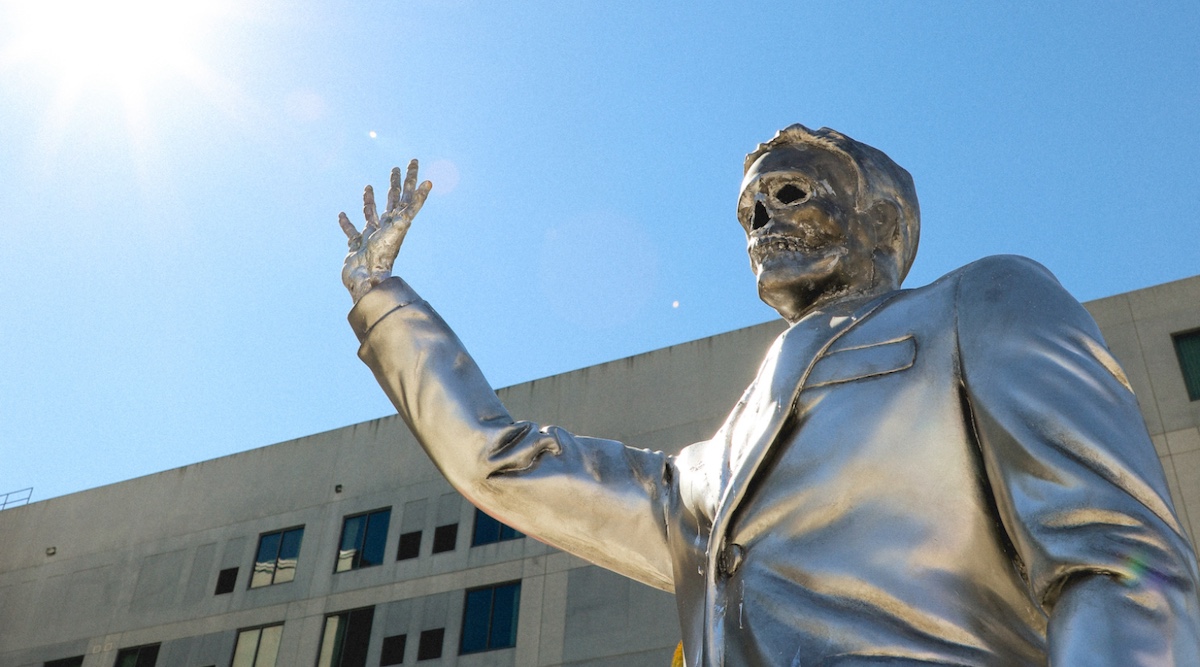
A life-size statue of Ron DeSantis melted in Tallahassee on Tuesday in a staged climate protest designed to confront the Florida governor's long record of climate denial. The non-profit 350 Action, art collective Uncommon Creative Studio, and advocacy group M ss ng P eces orchestrated the installation ahead of midterm elections to demonstrate the real-world consequences of inaction on rising temperatures.
The statue, made from a heat-reactive material, began deteriorating shortly after its public unveiling in front of supporters and observers. The deliberate choice of medium turned DeSantis's documented skepticism of climate science into literal visual metaphor. During his eight years as governor, DeSantis repeatedly downplayed or ignored scientific consensus on anthropogenic climate change despite Florida's acute vulnerability to sea-level rise and intensifying hurricanes.
The installation targets DeSantis at a moment when Florida faces accelerating coastal erosion and saltwater intrusion into freshwater aquifers. The state ranks among the most exposed to climate hazards in the nation. Yet DeSantis's administration resisted climate-forward policies and redirected environmental funding. His approach contrasts sharply with the scientific reality: Florida experiences "sunny day flooding" or "nuisance flooding" on regular high tides, a phenomenon directly linked to ocean level rise documented by NOAA and the U.S. Geological Survey.
The melting statue serves as performative activism. Environmental organizations increasingly deploy art installations and public spectacles to pierce through political noise, particularly during election cycles when voter attention fragments across competing messages. 350 Action, founded to mobilize climate action aligned with keeping global temperature rise below 1.5 degrees Celsius, has orchestrated similar interventions linking political figures to climate consequences.
The timing reflects strategic pressure on DeSantis ahead of the midterm elections. Florida voters, including many retirees and coastal residents directly threatened by climate impacts, increasingly support climate mitigation measures. Polling shows bipartisan concern about sea-level rise and storm intensification. The installation attempts to make that voter anxiety visceral by literalizing the stakes of DeSantis's climate stance.
Environmental advocates view such interventions as necessary correctives to political rhetoric divorced from physical reality. When elected officials deny or minimize climate science, activist groups argue that dramatic visual protests communicate what conventional advocacy cannot penetrate. The melting statue bypasses traditional media gatekeeping and generates organic social media circulation.
DeSantis's record on climate includes blocking climate-related regulations, limiting funding for resilience projects, and resisting emissions reduction targets. Florida's own environmental agency, the Department of Environmental Protection, operates under constraints that limit its climate authority. Meanwhile, cities like Miami Beach and Tampa independently fund adaptation infrastructure, recognizing that state leadership on climate remains absent.
The installation arrives as Florida's insurance markets contract due to climate risk, leaving thousands of homeowners unable to obtain coverage. Hurricane season intensification linked to warming oceans raises baseline flooding and wind damage expectations annually. These material conditions ground the protest's message in observable fact rather than speculation.
The melting statue demonstrates how climate activism has evolved from data presentation toward embodied performance. Whether such installations shift political calculation remains contested. Yet they operate in a registrar distinct from policy briefs or scientific papers, reaching audiences who otherwise encounter climate discourse filtered through partisan media landscapes.