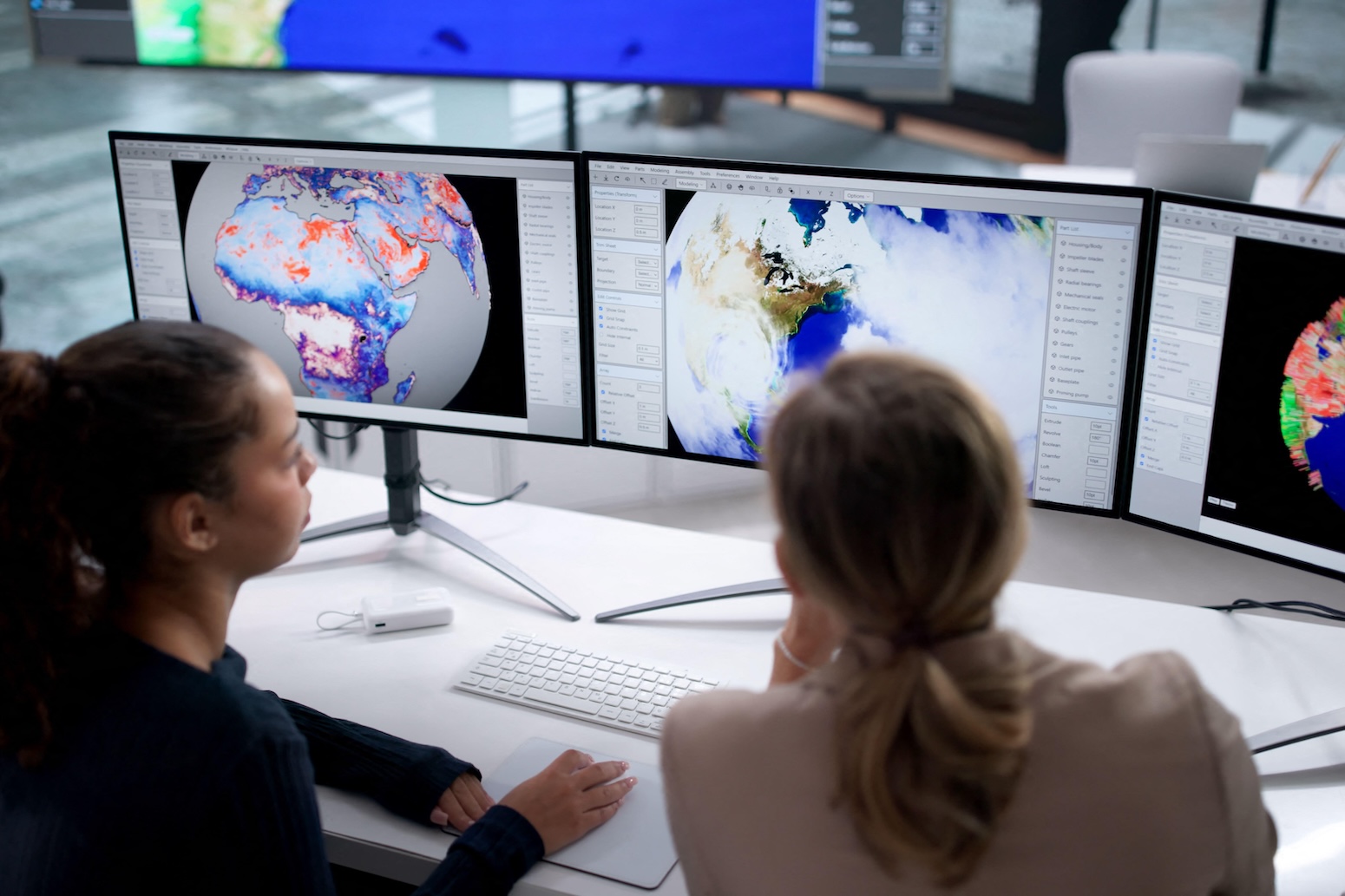
Climate scientists are deploying artificial intelligence tools to accelerate research on greenhouse gas emissions, predict extreme weather events, and analyze vast datasets that would take human researchers months or years to process manually.
Machine learning algorithms now help scientists identify patterns in historical climate data spanning decades. These systems detect subtle shifts in atmospheric composition, ocean temperatures, and ice sheet behavior. AI models trained on satellite imagery can track deforestation rates across the Amazon and monitor coastal erosion with precision impossible through traditional methods.
The technology addresses a core challenge in climate science: the sheer volume of information. Climate models generate terabytes of data daily from weather stations, satellites, and ocean buoys. Artificial neural networks process this information faster and often uncover relationships that conventional statistical analysis misses.
Predictive applications show particular promise. Researchers at leading institutions use AI to forecast the likelihood and intensity of hurricanes, typhoons, and heat waves days or weeks in advance. These systems learn from historical storm behavior to estimate future weather trajectories with improving accuracy. Early warning systems powered by machine learning give communities more time to prepare for dangerous conditions.
Carbon dioxide removal represents another frontier. Scientists employ AI to design new materials for direct air capture technology, which physically extracts CO2 from the atmosphere. Machine learning screens thousands of chemical compounds to identify those with the highest capture efficiency. This computational approach reduces laboratory time and accelerates the development timeline for carbon capture infrastructure.
Climate attribution science, which determines how much human activity caused specific weather events, relies increasingly on AI analysis. Researchers train algorithms on climate simulations with and without anthropogenic greenhouse gas emissions. These models then analyze observed weather patterns to quantify human responsibility for particular storms, droughts, or heat events.
Energy sector applications expand rapidly. AI optimizes power grid distribution for renewable energy sources like wind and solar. Machine learning algorithms predict wind speed and solar irradiance hours ahead, allowing grid operators to balance supply and demand more efficiently. This capability reduces waste and increases the proportion of clean energy on electrical systems.
Limitations exist. AI models require massive training datasets, which climate science sometimes lacks for rare extreme events. Computational costs remain substantial. Models trained on historical data may perform poorly as the climate system changes due to warming. Researchers must validate AI predictions against known physical laws and real-world observations to prevent overconfidence in algorithmic outputs.
Transparency poses another challenge. Complex neural networks operate as "black boxes," offering results without clear explanations of their reasoning. Climate scientists increasingly demand interpretability, requiring AI systems to show how they reached specific conclusions. This ensures findings can be challenged, replicated, and integrated with established climate physics.
Integration with traditional climate modeling continues. Scientists view AI not as replacement for physics-based models but as complement. Hybrid approaches combine machine learning's speed and pattern recognition with the explanatory power of equations governing atmospheric circulation, ocean currents, and radiation transfer.
Funding for climate AI research has grown substantially. Universities, government agencies, and private institutions recognize the tool's potential. Training programs now include machine learning alongside climate science fundamentals, preparing the next generation of researchers to work at this intersection.