# Repeal of Clinton-Era Roadless Rule Opens Midwest Forests to Logging and Development
The Trump administration's formal repeal of the Clinton-era Roadless Rule removes federal protections from roughly 58 million acres of national forest across the United States, including vast tracts of untouched Michigan wilderness that harbor endangered species and carbon-storing old-growth trees.
The Roadless Rule, enacted by President Bill Clinton in 2001, prohibited road construction and timber harvesting on roughly 58.5 million acres of national forest land. The regulation applied to about one-third of all federal forests. For over two decades, the rule protected fragile ecosystems from industrial development while maintaining habitat corridors for wildlife populations.
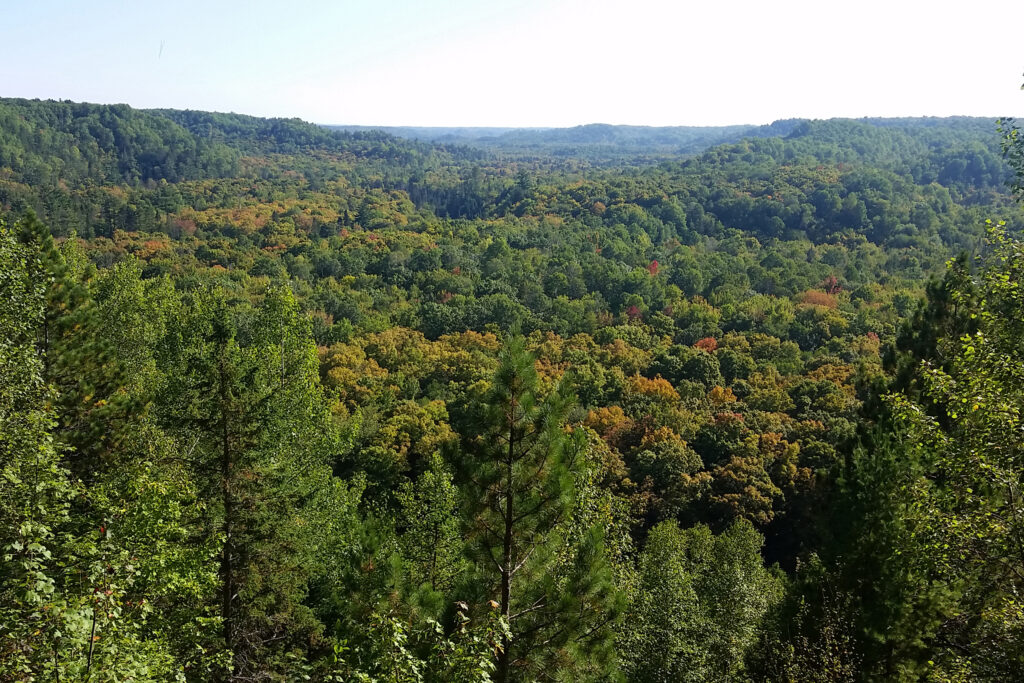
Michigan's Norwich Plains in the Upper Peninsula stands as a direct casualty of the repeal. The 145,000-acre expanse of unbroken wilderness consists primarily of northern hardwood forest dominated by sugar maples and old-growth aspens. The ecosystem supports critical populations of eastern gray wolves and American martens, both species listed under the Endangered Species Act. Beaver ponds dot the landscape alongside meadows and trout streams.
The removal of roadless protections opens this territory to logging permits and road construction that the U.S. Forest Service can now approve. Extractive industries have already signaled interest in timber harvesting operations across multiple Midwest forest blocks. Road construction fragments habitat, isolates wildlife populations, and enables access for resource extraction that damages water quality and soil integrity.
Old-growth forests like those in Norwich Plains store carbon at rates significantly higher than younger managed forests. Research published in Nature Climate Change estimates that protecting old-growth forests provides climate benefits equivalent to removing millions of tons of carbon dioxide annually. Logging these stands converts them from carbon sinks to carbon sources, releasing stored carbon while eliminating future storage capacity.
The repeal process bypassed environmental review requirements. The Forest Service issued the formal repeal without preparing an Environmental Impact Statement, relying instead on a Finding of No Significant Impact determination. Conservation groups including the Sierra Club and The Wilderness Society have announced legal challenges, arguing the agency violated the National Environmental Policy Act and the Administrative Procedure Act.
The Roadless Rule repeal restores authority to individual Forest Service regional offices and the Secretary of Agriculture to authorize road construction and logging on previously protected land. The decision enables timber sales that were previously categorically prohibited. Industry groups including the American Forest Resource Council have actively supported the repeal, citing potential timber availability.
State forestry officials in Michigan have expressed concern about the ripple effects on state-managed lands adjacent to national forests. Wildlife migration patterns and population genetics depend on connected landscapes. Fragmentation threatens long-term viability of wolf and marten populations that require large territorial ranges.
The repeal reverses decades of ecosystem-based forest management policy. Midwest wilderness advocates warn that Norwich Plains and similar forest blocks now face imminent commercial development unless Congress acts to restore protections or state legislatures enact parallel safeguards. Multiple conservation organizations have begun coordinating state-level legislative strategies as an alternative protection mechanism.