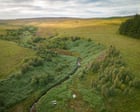
Restore, a nature restoration company, has purchased Emblehope Moor, a 7,500-acre expanse in northern Northumberland, for £8.5 million. The acquisition marks the largest single-ownership rewilding site in England, positioning the remote moorland as a potential model for landscape restoration that prioritizes ecological recovery over speculative profit.
The moor sits in one of England's most isolated regions, accessible only by gravel forest roads with no public transport or visible infrastructure. Restore's ownership structure diverges sharply from conventional land acquisition models. Investors funding the purchase will receive their financial returns, after which ownership transfers to community or charity organizations. This approach aims to remove speculative investment incentives that typically drive land consolidation and prevent public access or ecological management.
The timing reflects growing momentum in British rewilding. Over the past decade, conservation organizations and private investors have acquired thousands of acres across Scotland, Wales, and northern England specifically for habitat restoration. Projects like the Knepp Estate in Sussex and Cairngorms Connect in Scotland have demonstrated that large-scale land restoration can rebuild biodiversity while generating public benefits. Emblehope Moor's scale and transition model offer a different pathway.
Rewilding on moorlands presents distinct challenges compared to forested sites. The Northumberland moor has likely been actively managed for centuries, shaped by sheep grazing and game bird production. Restoration requires both removing intensive management practices and, paradoxically, often conducting active interventions like tree planting and predator reintroduction. Without these actions, degraded moorlands remain biologically impoverished.
The financial structure Restore employs addresses a core tension in British land conservation. Private capital has become essential for large acquisitions. Yet if ownership remains concentrated in investor hands, rewilded land often becomes inaccessible to the public and vulnerable to management shifts if financial incentives change. By building in a transition to non-profit ownership, Emblehope Moor creates permanence unavailable through voluntary conservation agreements that depend on individual landowner commitment.
Britain lacks the scale of public land designation seen in countries like the United States with the National Park Service. Instead, conservation depends on patchwork private initiatives, charitable trusts, and government schemes like Countryside Stewardship. Emblehope Moor demonstrates how structured investment can accelerate acquisition while maintaining long-term restoration goals.
The moor's restoration will likely involve expanding native woodland, reducing grazing pressure, and potentially reintroducing species like pine martens or red squirrels. These changes increase landscape heterogeneity and support invertebrate populations currently limited by moorland monoculture.
Success at Emblehope will test whether the Restore model attracts sufficient investor interest to scale across other degraded estates. If the financial returns prove competitive with conventional land investment, the precedent could reshape how Britain approaches its ecological deficit. The next phase reveals whether public benefit and private capital can genuinely align in practice, or whether the model requires subsidy or charitable patience to function.