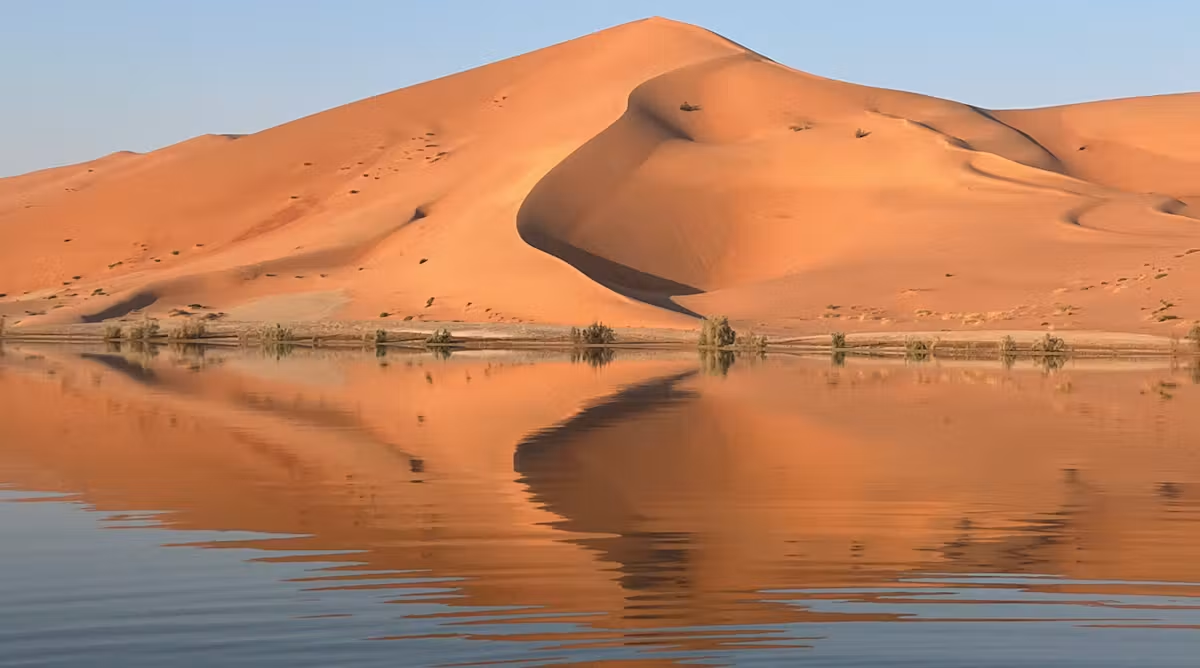
A new study published in Nature challenges the prevailing explanation for how stone-age humans spread across Arabia. Researchers found that while ancient lakes existed in the desert interior between about 122,000 and 67,000 years ago, they found no evidence that people lived beside them.
An eight-person expedition led by Rudolf Dellmour of the University of Vienna examined 125 areas across roughly 930 miles of the Rub' al Khali desert, the largest continuous sand sea on Earth at 650,000 square kilometers. The team discovered ancient lake deposits at 55 locations, including limestone beds, freshwater shells, and ostrich eggshell fragments. They found no stone tools.
The absence of tools and usable stone revealed the core constraint. Stone tools require rock that fractures in specific ways, such as chert, flint, quartzite, obsidian, and fine-grained basalt. In the central desert interior, chert-bearing rock formations dip beneath hundreds of meters of younger material. The interior lake basins sit more than 124 miles from the nearest known source of workable stone.
A computer model mapping the Arabian Peninsula showed that Middle Palaeolithic sites cluster in narrow zones where water and suitable stone coincide. Of terrain habitable based on water alone, 57 percent contained no workable stone. The researchers compared predictions against 363 known sites from the Middle Palaeolithic period.
Middle Palaeolithic people could carry stone a few hundred kilometers, but quantities fall steeply with distance. At well-studied European sites, most raw material comes from within 3 miles, and sources beyond 20 to 30 miles rarely contribute more than a few percent.
The pattern appears elsewhere, from the Libyan Sahara to the Tibetan Plateau and eastern North America. The researchers conclude that dispersal across Arabia moved from one habitable zone to another like an archipelago of islands, stalling where gaps grew too wide. Later toolmakers using smaller tools may have loosened this dependence on stone, enabling subsequent dispersals where earlier ones had stopped.