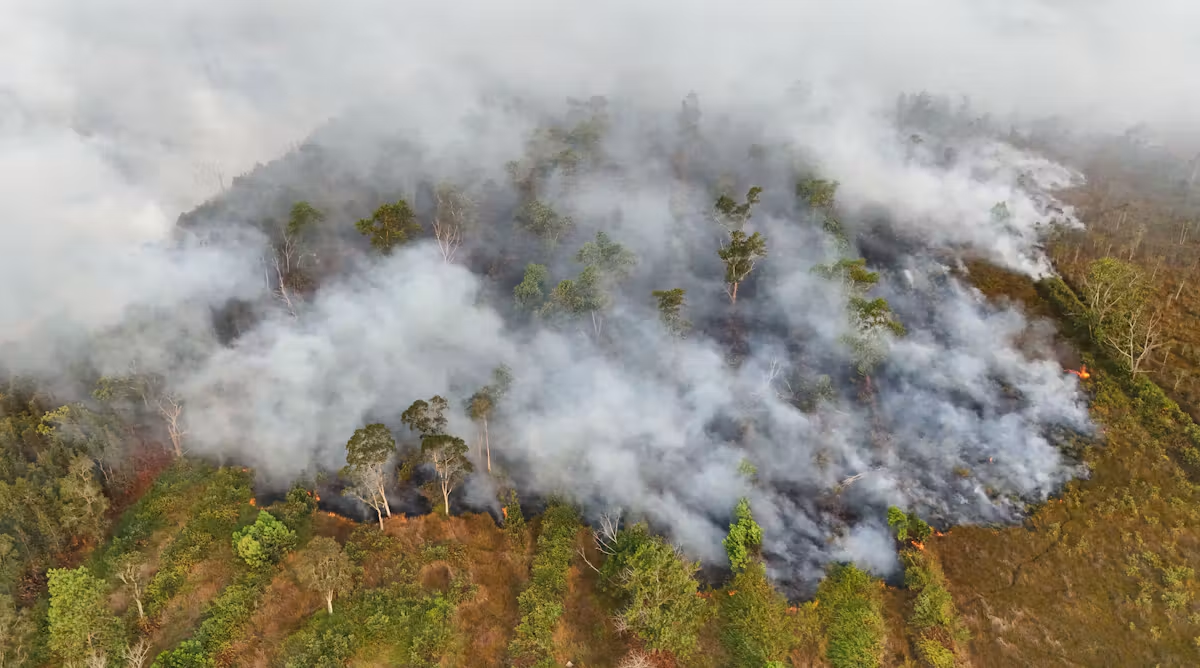
In September and October 2026, peatland fires in Indonesia's Palangka Raya region created air pollution levels equivalent to smoking 14 cigarettes per day, reaching 30 cigarettes on the worst days. Peatland fires burn both above and below ground, with underground fires smouldering for weeks or months, making them difficult to extinguish.
Peat stores carbon accumulated from dead plants over thousands of years. When it burns, that carbon releases into the atmosphere. Deeper fires release more carbon. An international team of researchers, including scientists from the University of Leeds and CIMTROP at Universitas Palangka Raya, traveled to the region to measure burn depth and carbon emissions.
Across ten sites, the team used drones and ground surveys to measure how deeply peat had burned. They collected soil samples and recorded greenhouse gas emissions from burned and unburned peat. At active fires, they measured carbon dioxide and methane released by smouldering peat.
Previous research indicates water levels need to remain within about 40 centimetres of the peat surface to reduce fire risk. This year, water tables measured between 2 and 4 metres below the surface, leaving large layers of dry peat available to burn.
In 2015, another El Niño year with similar fire intensity, Indonesia's peat fires released carbon dioxide faster than the entire European Union. Estimates of emissions from these fires remain uncertain because few direct measurements exist of how deeply peat burns.
The fires extend their impacts across borders. Smoke from Indonesian peatlands affects millions of people across south-east Asia, disrupting daily life and causing health problems. The team deployed 25 low-cost air pollution particle sensors to track smoke exposure during future fire seasons.
Peatland drainage and degradation, largely human-caused, makes peat more vulnerable to fires during droughts. Restoration through rewetting peat via wells or blocking drainage canals can reduce fire risk, though it cannot fully restore the fire resistance of intact peatlands.