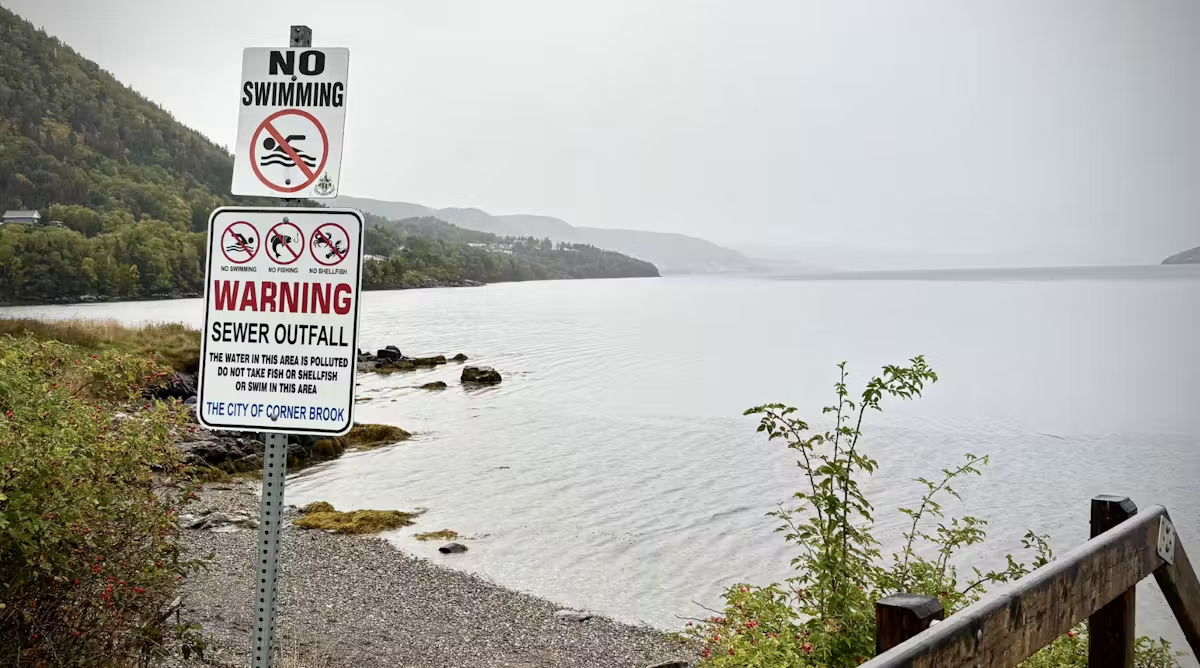
Raw sewage discharges contaminate waters across Newfoundland and Labrador, with 186 of 212 federally regulated wastewater discharge points having no treatment at all. Only three percent of wastewater systems in the province complied with federal Wastewater Systems Effluent Regulations (WSER) in 2021.
The WSER, enforced under the Fisheries Act since 2015, requires secondary-level wastewater treatment to meet national quality standards. Non-compliant municipalities must obtain "transitional authorizations" to continue discharging untreated sewage while submitting regular sampling data to federal authorities.
The City of Corner Brook releases over 20,000 square metres of raw, untreated sewage effluent into the ocean daily. The city has pursued provincial and federal funding for more than a decade to build a secondary treatment facility estimated to cost $120-130 million. In early 2026, the Department of Fisheries and Oceans served the city with an environmental directive, levying fines and threatening criminal charges. Corner Brook pays $60,000 annually to a private lab for water analysis required by federal reporting.
Small municipalities face compounding challenges from aging sewage infrastructure, blockages, line breaks and overflow. One town clerk estimated that 30 percent of a small community's budget could address other needs if not for water, sewage and wastewater monitoring costs.
Municipalities struggling to meet compliance requirements increasingly contract wastewater sampling and analysis to private companies. A 2019 report in The Telegram estimated that 80 percent of Newfoundland municipalities contract these services to one firm, Biomaxx Environmental. An elected official in a town of less than 500 residents described receiving an "$8,000 invoice" following a company visit.