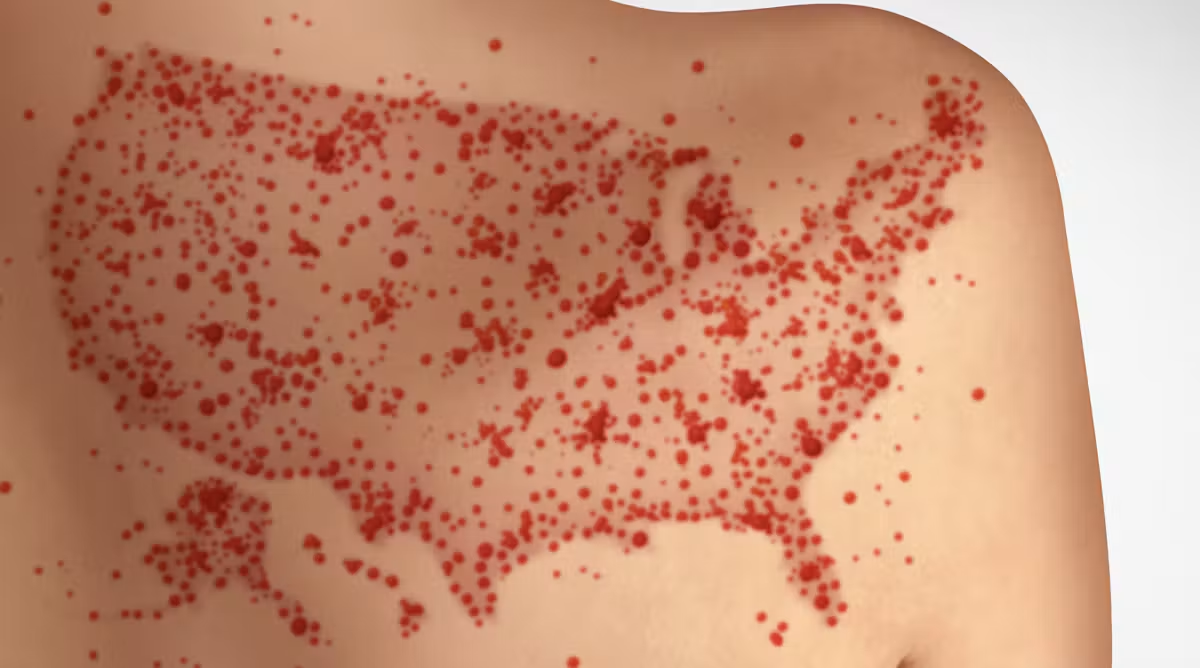
The United States lost its measles elimination status in November 2026, a designation it had held since 2000. The Pan American Health Organization, a regional office of the World Health Organization, made the determination based on the absence of local measles transmission for at least 12 months no longer being met.
Measles elimination requires herd immunity of at least 95% vaccination coverage. In 2025-26, only 92% of U.S. kindergartners received the MMR vaccine. Canada lost elimination status in 2025, as did the United Kingdom and other countries in Europe and central Asia in early 2026.
The MMR vaccine, introduced in 1971, is about 97% effective with two doses. Before vaccination, measles infected 3 to 4 million Americans annually, with tens of thousands hospitalized and hundreds dead. As of November 12, 2026, the CDC counted 5,412 cases for the year, the highest number since 1991, with 591 hospitalizations. Among children under 5, one in six were hospitalized. States reported 10 deaths in 2026.
Pennsylvania's outbreak produced 1,542 cases and 305 hospitalizations by November 13. Major outbreaks hit South Carolina, Utah, and Arizona. Utah's outbreak, which began in June 2025, has exceeded 12 months.
Vaccination rates fell from 95.2% in 2019-20 to 92.4% in 2025-26. Exemptions reached a record 4.2%. Of this year's cases, 96% were unvaccinated or of unknown status. Idaho had the lowest state rate at 75.2%.
A 1998 paper fraudulently linking MMR to autism was retracted in 2010, but the myth persists despite studies of millions of children finding no link. Misinformation accelerated during the COVID-19 pandemic. A 2025 KFF poll found parents who believed false measles claims were more than twice as likely to have skipped or delayed vaccines.
On August 10, 2026, President Donald Trump signed an order calling for MMR to be split into three single-disease shots, which are not sold in the United States. Health and Human Services Secretary Robert F. Kennedy Jr. suggested Pennsylvania's first two measles deaths "may even have been altogether fabricated" and promoted vitamin A and nutrition as measles treatments. The CDC classifies vitamin A as supportive treatment, not a cure or vaccine substitute.
Regaining elimination status requires at least 12 months without continuous transmission and will need stronger surveillance, faster outbreak response, and higher vaccination rates. Many career public health scientists lost jobs in 2025, substantially weakening surveillance capacity.