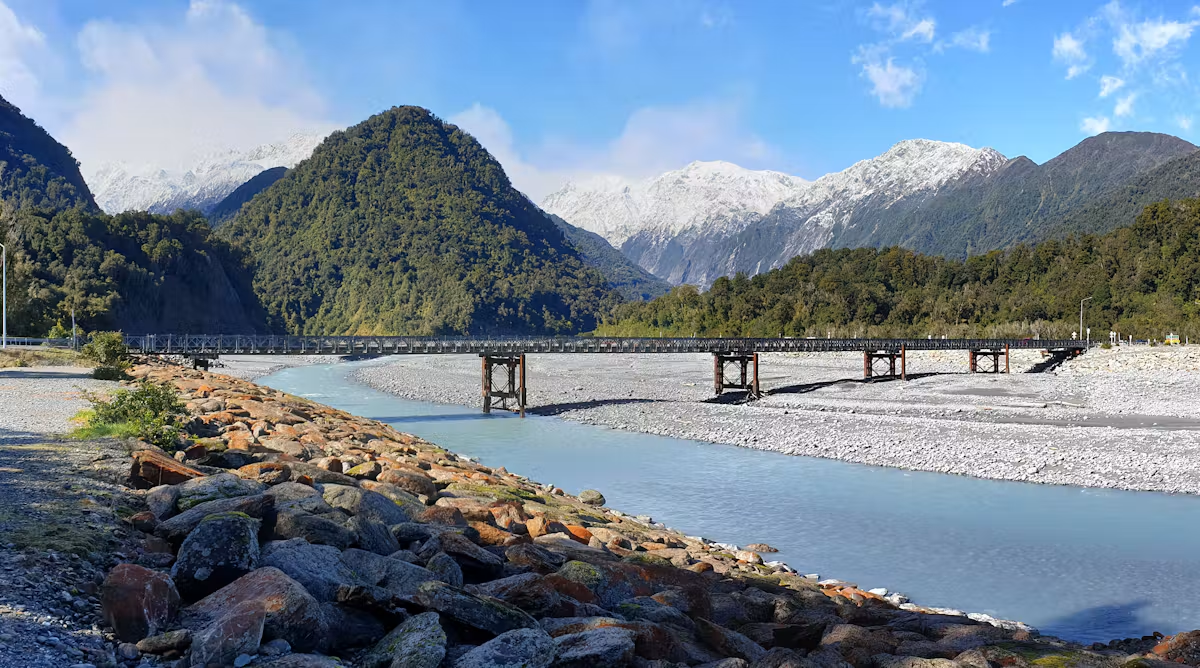
The Waiho River in Franz Josef/Waiau, South Island, rises about 20 centimetres a year, three times faster than its natural rate. This acceleration results from stopbanks built since the 1980s that confine the river to roughly one-third of its natural bed. Gravel that the river carries from the Southern Alps accumulates instead of spreading across the landscape, pushing the riverbed higher each year.
The independent Waiho Technical Advisory Group warned in 2023 that this rapid rise threatens the township, which hosts over a million visitors annually. The group recommended a ten-year plan to give the river more room to move and deposit gravel rather than relying on ever-higher stopbanks. When the group reconvened in August 2025, members found the river was changing faster than the plan was being implemented.
The Waiho has increasingly spilled north into the adjacent Tatare Stream since 2010. Between March 2025 and March 2026, the spillover point moved a kilometre upstream and the new channel cut down by two metres, surpassing modelled predictions. Erosion has already undermined the base of Havill's Wall, which protects the town's wastewater treatment ponds.
Confining the river creates a physical problem: feeding the same volume of gravel into a smaller area makes the riverbed rise faster. As the bed rises, the safety margin provided by stopbanks shrinks. Higher banks also mean any breach will release floodwater with greater force.
The group's recommendation was to release the river across its western floodplain, allowing gravel to spread over a larger area and slow pressure on the stopbanks. This would require relocating part of State Highway 6, removing landfills and farms from the western flats, and purchasing land. After three years, land purchases and relocation have not started, while highway planning remains in early stages.
Governance fragments responsibility. Flood protection, land-use planning, managed retreat, emergency management and local infrastructure fall to different organisations. No single body leads implementation. The authors propose a new group led by Westland District Council, including the West Coast Regional Council and central government agencies, with a mandate to accelerate work and pursue funding.
Independent experts have warned since 2002 that continuously raising stopbanks cannot continue. The authors state that what is missing is not information, but ownership and funding.