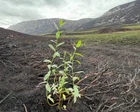
Three months after a catastrophic fire consumed 25 square kilometres of moorland and forest in the Cairngorms, Amanda Thomson's firsthand account reveals a landscape simultaneously devastated and determined to recover. The blackened moorland pines, dark as charcoal with needles singed an unnaturally rust colour, stretch far into the distance—a sobering reminder of summer's destruction. Yet within this charred expanse lies an unexpected narrative: nature is already reclaiming what was lost, and human intervention is accelerating that process.
The most encouraging sign is the coordinated restoration effort underway. Thomson witnessed the planting of over 3,000 trees—cell-grown goat and creeping willow, downy birch and alder—as part of an ongoing landscape restoration programme through the Cairngorms Connect Tree Nursery. These montane species, often miniature varieties, were selected specifically because they previously thrived in this habitat before being devastated by overgrazing. The fact that seeds were collected from nearby remnant populations and propagated locally demonstrates how recovery efforts can be grounded in ecological authenticity rather than generic reforestation.
Nature's own recovery mechanisms are equally remarkable. Thomson observed striking contrasts where burnt areas gave way to unscathed zones—bog asphodel and scabious blooming while black grouse leks carried on undisturbed. On the charred ground itself, new growth was already emerging: clumps of deer-grass, tiny bright green fronds of bracken and fern, and birch shoots breaking through the black undergrowth. Most intriguingly, pyrophilous fungi—fire-loving organisms that emerge in charcoal—are establishing themselves, creating biological conditions necessary to spark new growth.
The scale of damage, particularly in the forest where fire burned deep into roots and peat, remains daunting. Workers dealt with hotspots and 'smokers' a month after the fire, with some areas still off limits due to falling tree dangers. Yet Thomson's observation along the firebreak path near An Lochan Uaine and Meall a' Bhuachaille reveals that even autumn's natural cycle continues: birches and larches losing fiery leaves in recent storms while blaeberry shoots dot the charcoaled ground—renewal amid decline.
The Cairngorms fire represents a test of our commitment to landscape restoration and ecological recovery. Thomson's account demonstrates that while such devastation shocks us with its blackness and scale, the combination of natural resilience and strategic human intervention offers genuine hope. The work being done through the Cairngorms Connect Tree Nursery and associated programmes should serve as a model elsewhere, proving that even after catastrophe, landscapes can be deliberately and thoughtfully restored.