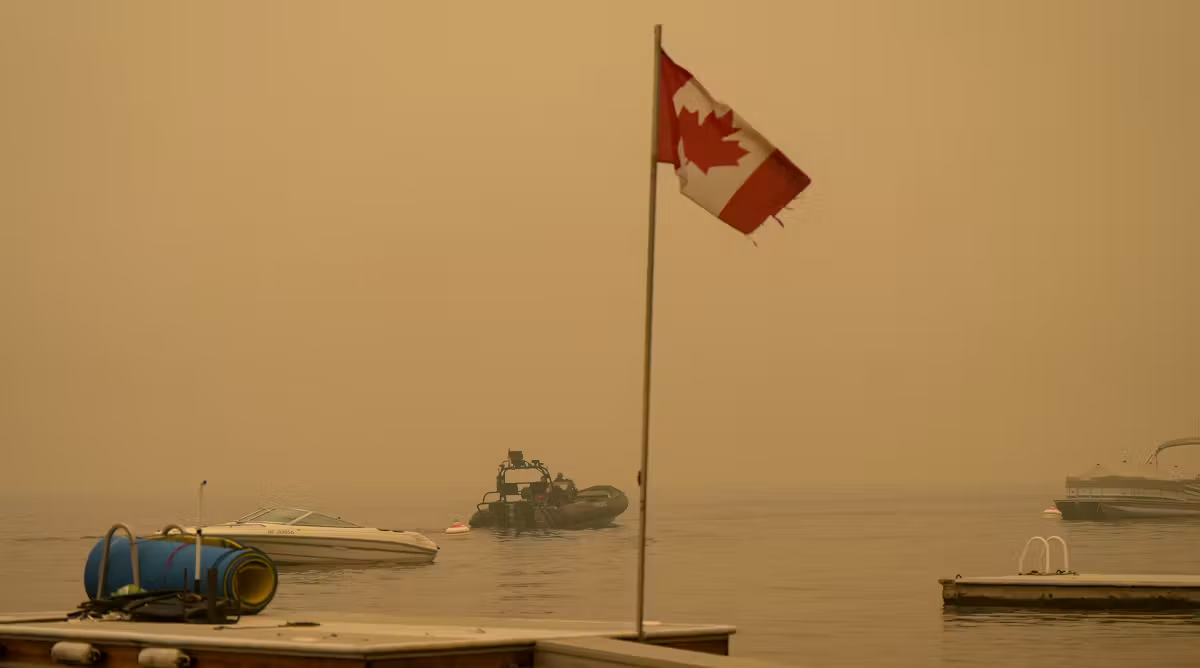
Canadian wildfires burned approximately 4.5 million hectares over the past summer, evacuating more than 33,750 people and exposing millions to hazardous air pollutants. The 2023 wildfire season was the most destructive in Canadian history, with economic consequences that could reach several billion dollars.
Research by Sian Kou-Giesbrecht and colleagues used a boreal wildfire-vegetation model to project climate change impacts on wildfire costs and carbon dioxide emissions through the 21st century. The model accounts for interactions between weather, forest growth, lightning, human ignitions, and suppression.
Limiting global warming to 2 degrees Celsius above pre-industrial temperatures would keep burned area, number of exposed Canadians, and wildfire costs comparable to recent decades. High greenhouse gas emissions and rapid climate change could expose an additional 180,000 Canadians to wildfire annually by century's end. Those figures include people living within 50 kilometres of a fire, not the wider reach of wildfire smoke.
Additional costs for fire suppression, lost timber, and lost outdoor recreation opportunities could reach up to $870 million per year by the end of the century. The researchers note this estimate does not include evacuation, property damage, infrastructure loss, business interruption, or smoke-related health impacts, currently estimated at $19 billion per year.
Approximately 78 per cent of exposed communities are primarily Indigenous, although they represent only 17 per cent of communities in the study. The generation born in the 2020s could experience nearly three times the lifetime wildfire exposure of those born in the 1960s in a high-emissions future.
Canadian wildfire emissions in 2023 were comparable to annual fossil fuel emissions of several large nations, surpassed only by India, China, and the United States. Using the social cost of carbon, researchers estimated that additional worldwide damages from Canadian wildfire CO2 emissions could reach up to $50 billion per year by century's end in a high-emissions scenario.
The Canadian government committed $317 million over five years for additional firefighting aircraft and $48 million over five years for Parks Canada wildfire preparedness. These investments are small compared to projected direct wildfire costs of $100 million to $870 million annually by century's end, the researchers stated.