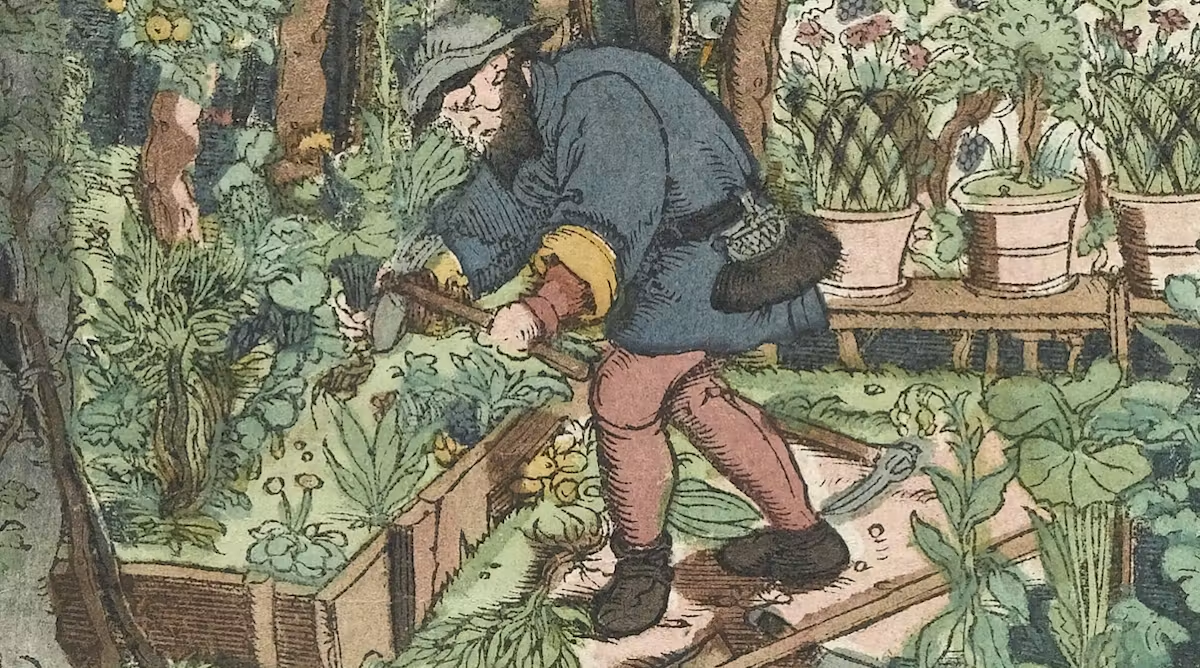
Wahlafrid Strabo, a 9th-century Benedictine monk at the monastery of Reichnau, composed the Hortulus (The Little Garden), a work combining poetry with practical gardening advice that remains influential among modern gardeners today. The text names twenty-nine plants, mostly medicinal, including Indian pepper, grapes, nettle, pennyroyal, and peach. Strabo noted that Southernwood "has power against fevers, banishes stitch" and provides relief from gout. He also documented the use of fennel-root mixed with wine for cough relief and betony for treating septic wounds.
Alexander Neckham, an English Augustinian canon writing around 350 years later in his work On the Nature of Things, compiled a longer list of garden plants including parsley, coriander, garlic, and citrus fruits, while emphasizing the importance of both hard work and plant study.
Medieval monks drew on earlier texts such as the medical writings of Dioscorides (c.40-c.90 AD), which became a standard reference in Europe. The mid-12th century library catalogue of Durham Cathedral Priory lists works by Isidore, Bede, Macer, and Dioscorides on botanical knowledge.
Most monasteries maintained gardens. The ninth-century Plan of St Gall, an idealized monastery layout, shows a main kitchen garden and orchard. Monastic communities managed land, livestock, and waterways while keeping detailed records.
At Rievaulx Abbey in the valley of the Rie in North Yorkshire, monks coppiced woodlands for pig foraging over many years. They used terracing to make land more usable and channeled water for sanitation and to supply mills. At Durham Cathedral Priory, monks altered the course of the river Wear in medieval times, a change revealed in 2009 when heavy rain exposed the ancient riverbed.
The 12th-century theologian William of St Thierry described gaining spirituality from shady woodland. The Grandmontines, another order, lived in communities of no more than twelve and practiced self-sustaining agriculture with no excess. Modern gardening movements have absorbed monastic ideas of sustainability, self-sufficiency, and finding spirituality in green spaces.