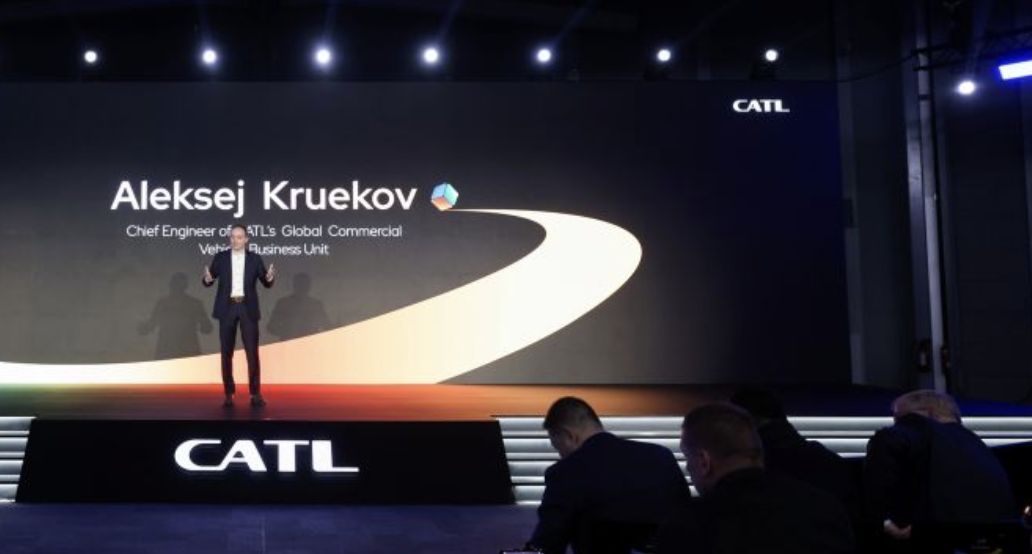
Contemporary Amperex Technology Co. Ltd. (CATL), the world's largest battery manufacturer by market share, unveiled its TECTRANS II battery platform at the IAA Transportation 2026 trade show in Hanover, Germany. The modular system targets heavy-duty commercial vehicles with a heavy-duty variant delivering up to 1,000 kilometers of driving range per charge.
The platform represents CATL's push into the commercial trucking electrification market, a sector still dominated by diesel engines in most regions. The 1,000-kilometer range addresses a core barrier to fleet adoption. Long-haul trucking requires extended range without frequent charging stops that disrupt delivery schedules and reduce operational efficiency.
TECTRANS II incorporates megawatt-level charging capability, enabling faster replenishment of energy compared to existing commercial EV platforms. Megawatt-class charging systems can deliver power in the 1-4 megawatt range, cutting charging times significantly. For trucking operations, this translates to shorter stops at distribution centers or dedicated charging hubs, reducing downtime costs that operators incur during battery replenishment.
The platform's modular design allows fleet operators to configure battery capacity and range based on specific route requirements. Modular systems reduce manufacturing complexity and lower costs by allowing CATL to standardize components while enabling different pack configurations. This flexibility addresses the heterogeneous needs of commercial fleets, where some routes require regional delivery within 300-400 kilometers daily while others demand longer intercontinental distances.
CATL's announcement at IAA Transportation comes as European and global heavy-duty vehicle manufacturers accelerate electrification timelines. The European Union's Euro 7 emissions standards, finalized in December 2023, impose stricter limits on nitrogen oxides and particulate matter from trucks starting in 2026. While electric powertrains avoid direct tailpipe emissions, battery suppliers must simultaneously solve range anxiety and cost-competitiveness challenges that have delayed truck fleet conversions.
Global EV battery capacity installed in commercial vehicles reached 247 gigawatt-hours in 2023 according to BloombergNEF, but heavy-duty trucks represented a fraction of that total. Commercial vehicle electrification lags passenger car adoption by 4-6 years in most markets. Price parity between diesel and electric trucks remains elusive. Battery costs for heavy-duty applications still exceed $120 per kilowatt-hour in most markets, compared to $100-110 per kilowatt-hour for passenger vehicles.
CATL commands approximately 37 percent of the global battery market as of 2024. The company manufactures lithium iron phosphate (LFP) and nickel-based chemistries for different applications. LFP batteries, cheaper and safer than nickel-based alternatives, increasingly power heavy-duty and commercial vehicles despite slightly lower energy density.
The TECTRANS II announcement reflects CATL's strategy to diversify beyond passenger vehicles as growth in that segment moderates. Commercial vehicle electrification represents a multi-billion-dollar market opportunity through the 2030s. Chinese battery makers including BYD and Geely have similarly prioritized heavy-duty platforms in recent years.