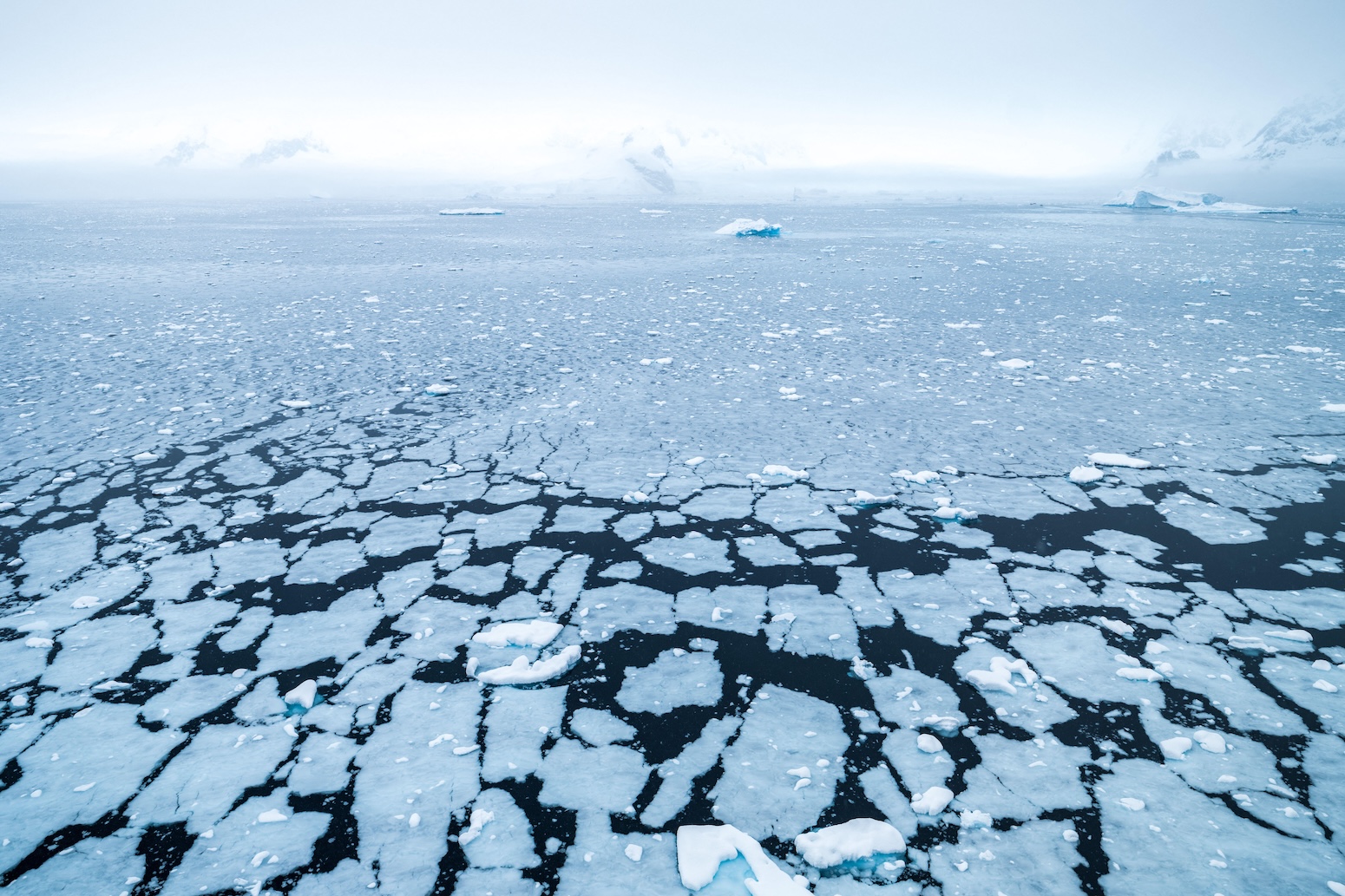
Antarctic sea ice reached its third-lowest winter peak in recorded history this year, extending only 16.96 million square kilometers at maximum extent. Satellite measurements spanning nearly five decades show a troubling pattern. The two years with lower peaks both occurred recently—2022 and 2023—signaling an accelerating decline in Southern Ocean ice coverage.
Winter sea ice in Antarctica expands and contracts seasonally. Maximum extent typically arrives in September, at the end of the Antarctic winter. This year's peak falls dramatically short of the 1991-2020 average of 18.71 million square kilometers. The shortfall ranks as the third-most severe on record since the National Oceanic and Atmospheric Administration (NOAA) and NASA began tracking Antarctic sea ice via satellite in 1978.
The decline matters beyond abstract statistics. Antarctic sea ice acts as a critical habitat for krill, penguins, seals, and whales. It reflects solar radiation back to space, helping regulate planetary temperatures. Reduced ice coverage means less breeding ground for marine life and reduced albedo effect, both consequences that ripple through polar ecosystems and potentially influence global climate patterns.
Scientists describe the trend as concerning. The clustering of record lows in consecutive years—2022, 2023, and now 2024 ranking among the three lowest—suggests something fundamental has shifted. While Antarctic sea ice exhibited more variability than Arctic ice historically, the recent consistency of extreme lows contradicts earlier assumptions about Southern Ocean resilience.
Multiple factors drive this decline. Rising ocean temperatures warm the water below sea ice, reducing formation rates. Atmospheric circulation patterns have shifted, with wind patterns and pressure systems now less favorable for ice expansion. Climate models consistently project further Antarctic sea ice loss as greenhouse gas concentrations rise.
The Antarctic presents a more complicated climate story than the Arctic. Arctic sea ice has declined steadily for decades as polar temperatures warm twice as fast as the global average. Antarctic sea ice initially showed slight increases through the early 2010s, confusing researchers about regional climate sensitivity. That ambiguity has evaporated. Since 2016, Antarctic sea ice has declined sharply.
This winter's low peak carries immediate biological consequences. Emperor penguin colonies depend on stable sea ice for breeding. The Ross Ice Shelf region, home to multiple emperor penguin populations, experienced particularly low ice coverage. Breeding failures in consecutive years can devastate population stability. Some colonies showed abandoned nests as ice melted prematurely.
The data comes from satellite passive microwave radiometers aboard NOAA and NASA platforms. These instruments measure microwave radiation emitted by sea ice, allowing scientists to calculate ice extent with precision to within 15 kilometers. The consistency of measurement across 48 years makes the recent trend credible and alarming.
Antarctic sea ice decline receives less public attention than Arctic ice loss, partly because it affects fewer human communities directly. Yet the Southern Ocean's role in global ocean circulation, nutrient cycling, and carbon storage makes Antarctic ice critical to planetary systems. The third consecutive year of near-record lows indicates this region transitions from anomaly to new baseline.