# Tesla Opens Supercharger Network to Non-Tesla EVs on Massachusetts Turnpike
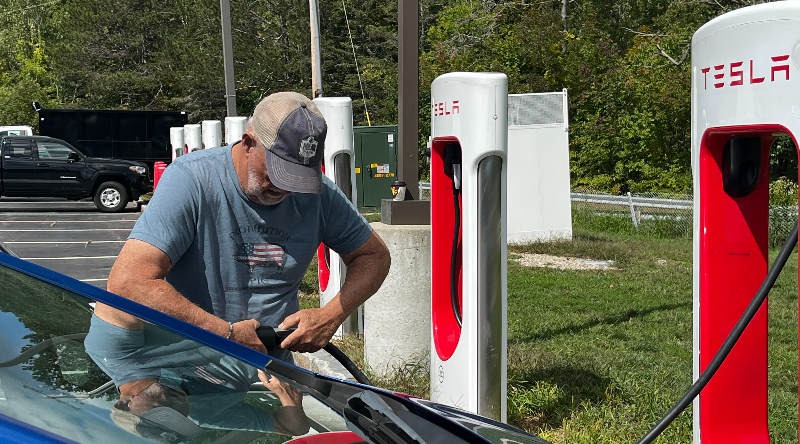
Tesla has expanded access to its Supercharger network along the Massachusetts Turnpike, allowing non-Tesla electric vehicles to charge at stations previously reserved for Tesla owners. The move represents a continuation of Tesla's 2021 decision to open its charging infrastructure to other EV manufacturers, a shift that accelerates adoption of standardized charging across North America.
The Massachusetts Turnpike deployment marks another step in Tesla's transition from a proprietary charging advantage to a broader infrastructure provider. This aligns with the company's earlier openings in California, New York, and other high-traffic corridors where competitive EV adoption has intensified. Non-Tesla EV owners can access these chargers using the Tesla mobile app or through third-party networks that partner with Tesla's infrastructure.
The timing addresses a critical bottleneck in EV infrastructure. The Mass Pike carries roughly 200,000 vehicles daily and connects Boston to Albany, New York. For long-distance EV travel along this corridor, charging availability directly influences purchase decisions. Studies from the Department of Energy show that range anxiety remains the second largest barrier to EV adoption, after upfront vehicle cost. Expanding charger access on major highways removes this obstacle for drivers of Chevrolet Bolt EVs, Ford F-150 Lightnings, Hyundai Ioniq 6s, and other competing models.
Tesla operates approximately 60,000 Supercharger connectors globally as of 2026. The company added roughly 8,000 new locations in 2025, accelerating deployment to compete with other charging networks operated by Electrify America, EVgo, and regional operators. Unlike proprietary systems, Tesla's recent openings use the North American Charging Standard (NACS), adopted by Ford, General Motors, Hyundai, Kia, and others. This standardization reduces fragmentation that once forced EV owners to carry multiple adapters or plan routes around brand-specific chargers.
Massachusetts policy has supported charging expansion through state incentives and permitting streamlines. The state's climate goals require 1.75 million EVs on roads by 2030, up from roughly 350,000 currently registered. Highway charging directly supports this target by enabling EV ownership in rural and suburban areas where long commutes were previously impractical.
Drivers report charging speeds between 200 and 350 kilowatts at Tesla Superchargers, reducing 10 to 80 percent battery charge time to roughly 25 minutes. These speeds exceed most competing networks, where average speeds range from 150 to 250 kilowatts. Faster charging reduces friction in EV adoption by shortening travel delays to competitive levels with gas stations.
The Massachusetts Turnpike expansion also reflects Tesla's revenue strategy shift. The company now views charging as a long-term revenue stream rather than a customer acquisition tool. Non-Tesla drivers pay per kilowatt-hour charges that generate consistent income. This business model incentivizes continued network expansion into less profitable rural markets where competing networks hesitate to invest.
Industry observers expect continued NACS standardization across private networks. Charging operators increasingly view interoperability as essential to market viability. Non-Tesla EV owners have fewer charging barriers than three years ago, supporting state and federal goals to electrify transportation.