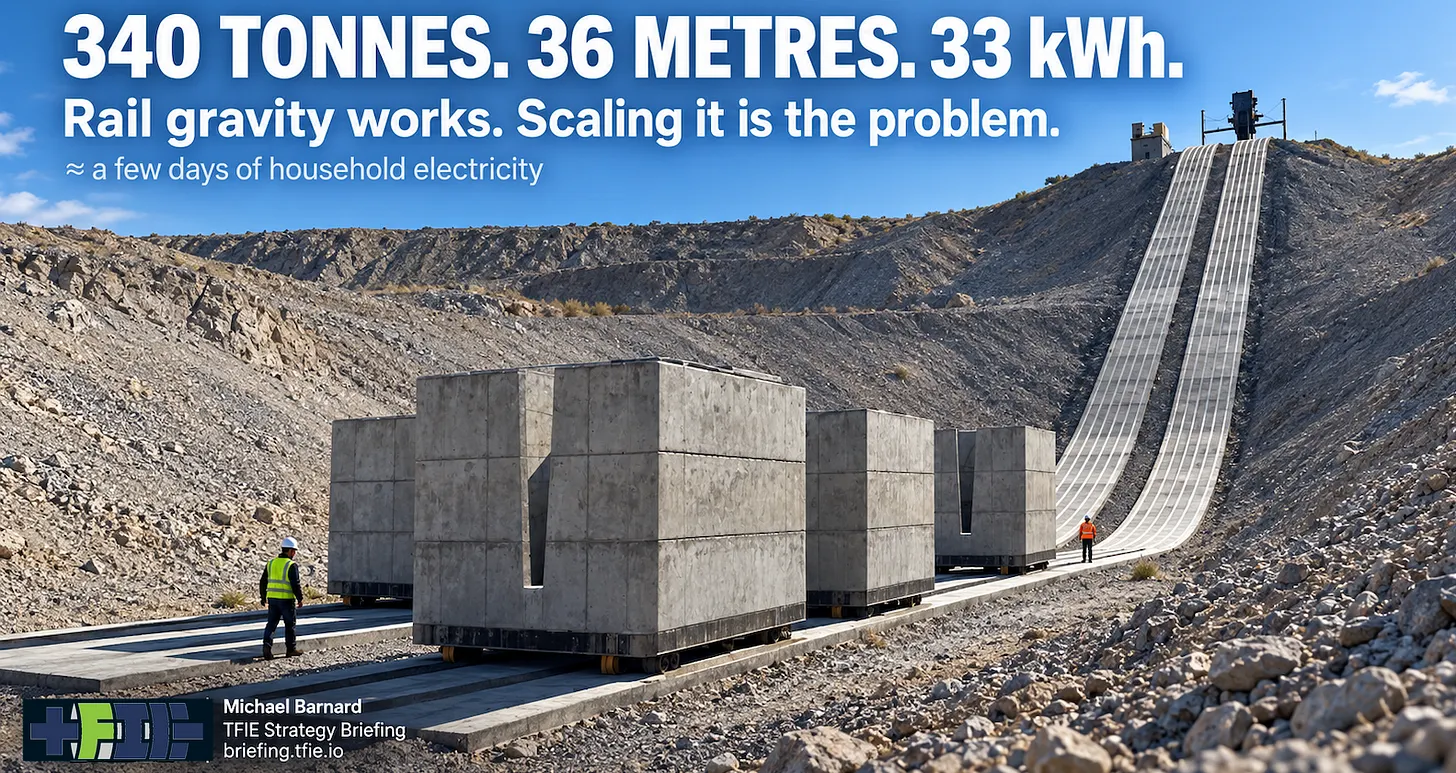
ARES North America's gravity energy storage demonstration in Nevada exposes fundamental engineering problems that undermine the technology's viability for grid-scale energy storage, according to data from Sandia National Laboratories.
The GravityLine system at Gamebird Pit operates by moving two mass cars, each weighing approximately 340 tonnes, up and down an inclined track. The system stores energy by lifting heavy loads during periods of low electricity demand, then releases that energy by lowering the cars to generate power when demand increases. Sandia's testing reveals severe constraints that limit practical application.
The core issue centers on energy density and operational efficiency. Moving 340-tonne cars on rails demands substantial infrastructure and produces modest energy returns relative to system scale. The round-trip efficiency losses from friction, mechanical stress, and material degradation accumulate during repeated cycles. Physics calculations demonstrate that the energy gained from lowering such loads falls short of what proponents claimed before deployment.
ARES pitched gravity storage as an alternative to lithium-ion batteries and pumped hydroelectric systems. The company argued that gravity systems could provide long-duration storage at competitive costs. The Nevada demonstrator was designed to validate this approach at utility scale before broader deployment.
Sandia's documentation reveals operational realities that basic physics predicts. Inclined rail systems require precise mechanical tolerance across extended distances. The load-bearing infrastructure must withstand repeated stress from moving heavy cars. Material fatigue compounds over thousands of charge-discharge cycles. These factors collectively reduce effective cycle life and increase maintenance costs beyond earlier projections.
The economics become unfavorable at scale. Capital costs for constructing miles of reinforced inclined track infrastructure exceed initial estimates. Operating costs for maintenance and repairs mount as the system ages. Downtime for repairs reduces the system's ability to respond to grid demands. These operational constraints mean gravity storage delivers lower energy throughput than competing technologies on a per-dollar basis.
Other gravity storage approaches face similar hurdles. Compressed air systems require geological formations with specific characteristics. Flywheel storage systems work at smaller scales and cannot match the duration that long-duration grid storage demands. Pumped hydroelectric facilities depend on geography and water availability that limit deployment locations. Each technology occupies a specific niche where geography, geology, or application align with its strengths.
The Nevada demonstrator's poor performance does not eliminate energy storage as a solved problem. Lithium-ion battery costs continue declining. Flow battery technologies show progress in early deployment. Thermal storage systems convert excess electricity to heat or cold, storing energy with distinct advantages for certain applications.
ARES' Nevada results highlight why rigorous engineering validation precedes commercial deployment. Systems that appear promising in theoretical models often encounter practical limitations when tested at meaningful scale. The GravityLine failure demonstrates that existing proven technologies still dominate grid storage for good reason. Innovation requires overcoming real physics constraints, not bypassing them.
This outcome shapes investment priorities across the energy storage sector. Capital flows toward technologies with demonstrated performance at scale. Companies pursuing gravity storage must now overcome the credibility damage from failed demonstrations. Investors scrutinize energy storage claims more carefully after ARES' Nevada results. The market rewards working solutions rather than elegant theories.