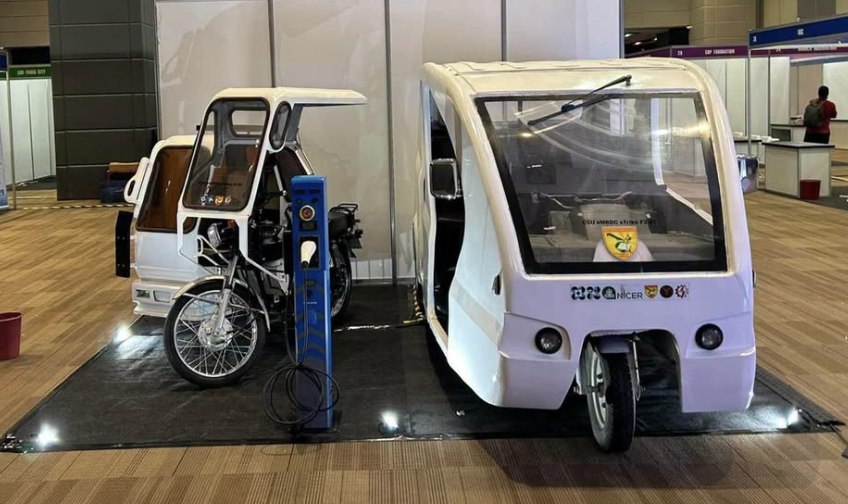
Cagayan State University has opened its electric tricycle technology to commercial manufacturers, marking a transition from prototype development to market deployment in the Philippines. The university's ElectroMobility Research and Development Center (EMRDC) unveiled the locally designed vehicles at Manila's Sustainability Expo 2026, signaling readiness for scaled production.
The move addresses a transportation gap in Southeast Asia's third-largest economy. Tricycles serve as primary public transit in rural and urban areas across the Philippines, with an estimated 1.5 million units currently operating on roads. Most rely on gasoline or diesel engines, making them major contributors to urban air pollution and greenhouse gas emissions in metro Manila and other cities.
CSU's electric tricycle platform represents domestic innovation in vehicle electrification, a sector historically dominated by imported Chinese and Indian models. Local manufacturing reduces supply chain dependencies and creates production jobs. The university has licensed its design specifications to commercial partners, allowing manufacturers to begin tooling and component sourcing without developing electric architectures from scratch.
Electric tricycles offer practical advantages for Philippine transportation networks. Operating costs drop by 60 to 70 percent compared to combustion engines when charged on grid electricity. Maintenance expenses fall because electric motors contain fewer moving parts than internal combustion engines. Noise pollution decreases substantially in residential areas where tricycles operate as shuttle services.
Battery performance in tropical climates remains a technical consideration. The EMRDC designs account for Philippines heat and humidity through thermal management systems and sealed battery enclosures. Charging infrastructure deployment will determine adoption rates. Current grid capacity in most provincial cities cannot support rapid charging stations without infrastructure upgrades costing millions in local and national investment.
The Philippine government has supported electric vehicle adoption through the National Renewable Energy Program, which targets 35 percent renewable energy by 2030. Transport electrification contributes to this goal. The Department of Transportation has issued guidelines permitting electric tricycles with modified safety specifications, clearing regulatory pathways for commercial operation.
Market barriers remain substantial. Initial purchase prices for electric tricycles still exceed gasoline models by 40 to 50 percent despite lower operational costs. Tricycle operators typically own single vehicles and operate on thin margins, limiting capital for new technology. Financing programs from banks remain limited. Rural electrification gaps in Mindanao and the Cordillera regions restrict charging access.
CSU's licensing approach distributes development risk across multiple manufacturers rather than concentrating production at a single facility. This strategy mirrors successful adaptation models in other Southeast Asian countries where university-developed technologies reached scale through decentralized manufacturing partnerships.
Emissions reductions from tricycle electrification could reach significant levels given fleet size. A single gasoline tricycle produces roughly 2 tons of CO2 annually. Fleet-wide conversion of 500,000 units would eliminate approximately 1 million metric tons of CO2 yearly, equivalent to removing 200,000 cars from roads. National transportation emissions comprise 32 percent of total Philippine greenhouse gas output according to the Climate Change Commission.
Commercial partners have committed to production timelines starting in 2027. Manufacturing locations in Calabarzon, Bulacan, and Cagayan Valley will supply domestic demand first before exploring exports to Vietnam, Thailand, and Indonesia where similar transportation networks operate.