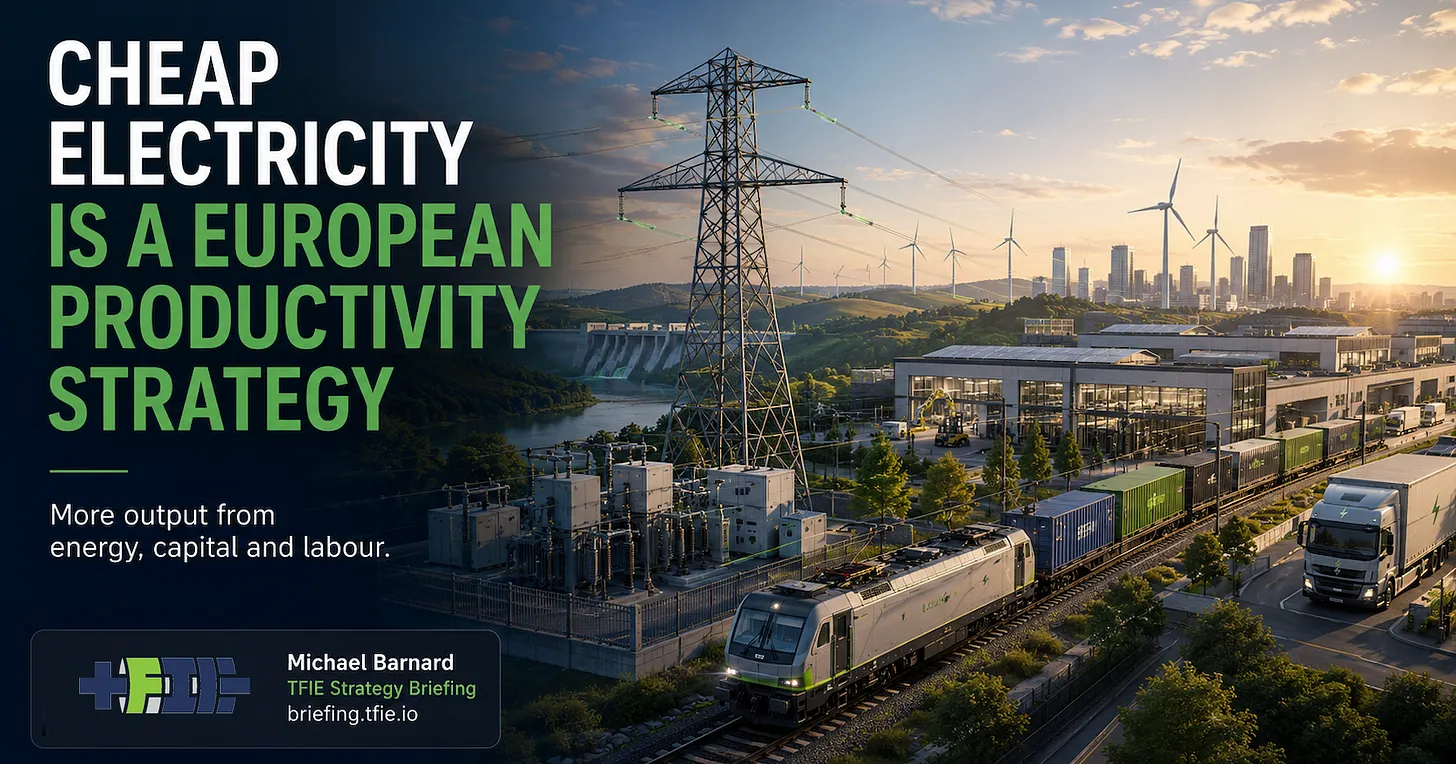
Europe faces a productivity crisis rooted in energy costs and workforce scarcity, according to an analysis centered on former European Central Bank chief Mario Draghi's competitiveness diagnosis. The continent's economic stagnation reflects not a single problem but a cascade of structural failures, starting with expensive electricity that undermines manufacturing competitiveness globally.
Draghi identified weak productivity as Europe's central economic weakness. The EU's labor force is shrinking while the continent remains locked in debate over coal and gas infrastructure, despite dependence on imported fossil fuels. This contradiction, the analysis argues, produces an incoherent energy strategy that locks in high costs while failing to invest in the low-carbon transition needed to compete with North America and Asia.
Energy prices matter directly to industrial competitiveness. European manufacturers pay substantially more for electricity than U.S. counterparts, a gap widened by reliance on imported natural gas and the cost of carbon allowances under the EU Emissions Trading System. This price disadvantage flows through supply chains. Cement, steel, fertilizer, and chemicals all require energy-intensive production. When European facilities face higher input costs, they lose contracts to competitors in regions with cheaper power or weaker climate regulations.
The fragmentation across EU member states compounds this problem. Energy markets, grid infrastructure, and industrial policy remain balkanized. A German steelmaker cannot easily relocate to Poland for cheaper electricity without navigating regulatory hurdles. Investment in cross-border transmission capacity lags. Research funding remains nationally siloed rather than coordinated at continental scale. These barriers prevent efficient capital allocation and slow the deployment of renewable energy infrastructure.
Draghi's diagnosis extends beyond electricity. Europe's demographic collapse eliminates the assumption of workforce growth that underpinned postwar economic models. Fewer workers per retiree means productivity gains become the only path to rising living standards. That requires continuous innovation and capital investment, yet European venture capital and private equity markets remain underdeveloped compared to the U.S. Tech companies face barriers to scaling across borders. Regulatory fragmentation raises compliance costs.
Cheap electricity alone cannot reverse these trends, but it provides essential foundation. Renewable energy deployment offers dual benefits: lower operating costs for industry and freedom from fossil fuel price volatility tied to geopolitical disruption. Solar and wind infrastructure, once installed, generates power at marginal cost near zero. That advantage compounds across decades of plant operation. European manufacturers could undercut global competitors if given access to abundant, cheap renewable power.
The path forward requires integrated action. Grid modernization must accelerate to integrate distributed renewables and enable cross-border transmission. Member states must harmonize industrial policy while maintaining competition. Investment in automation and artificial intelligence becomes urgent as labor scarcity worsens. Carbon pricing should remain but must pair with targeted support for heavy industry during transition.
Without these changes, Europe risks permanent loss of manufacturing capacity and technological leadership. Asian and North American competitors have already moved faster on renewable deployment and have lower structural costs. The window for Europe to rebuild competitive advantage narrows each year investment delays. Cheap electricity through renewable scaling offers a foundation. Everything else builds from that.