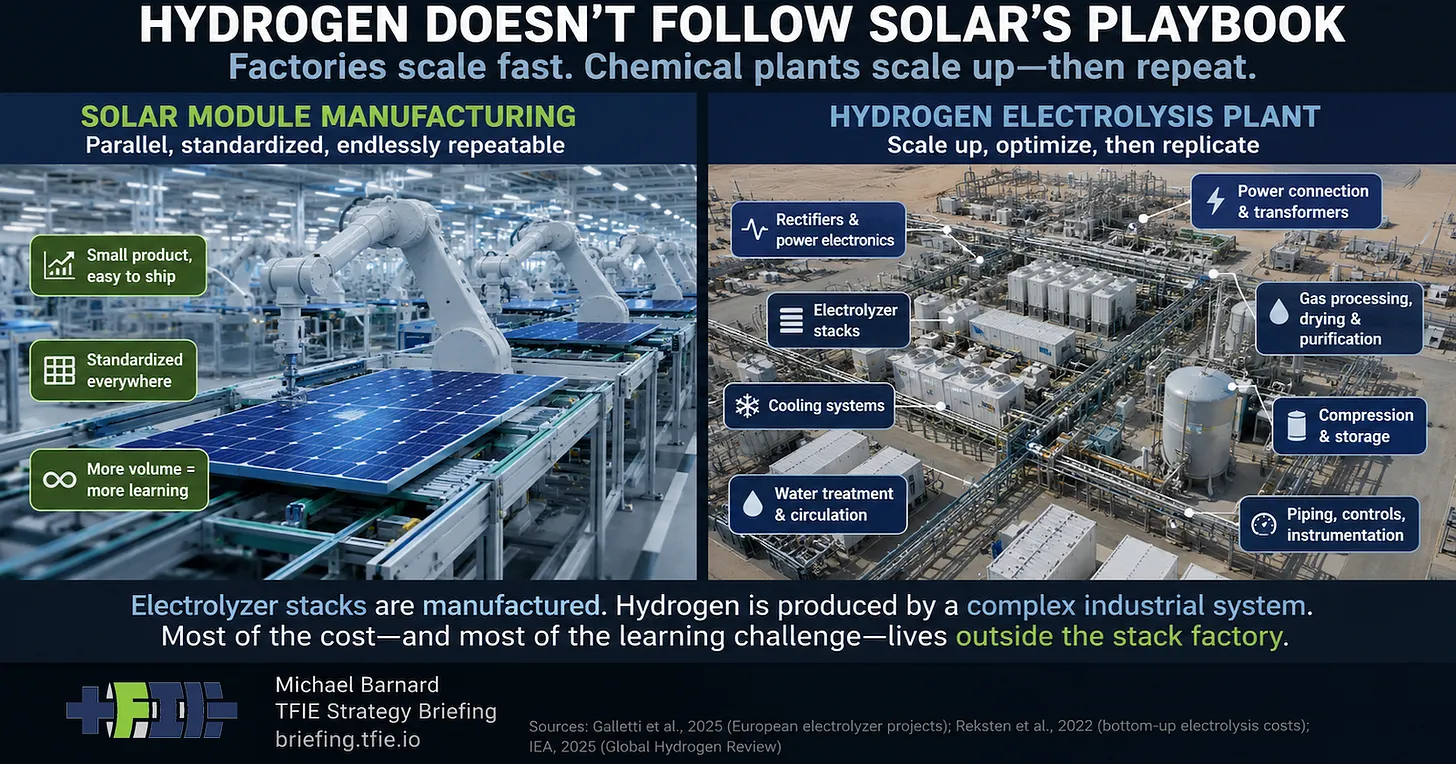
Hydrogen cost forecasts rely heavily on experience curves, a methodology that has worked well for solar and wind but may systematically miscount progress in electrolyzer technology. The experience curve approach assumes that each time cumulative production doubles, costs fall by a consistent percentage. Analysts then project future doublings to estimate long-term price declines.
The problem lies in how doublings get counted for hydrogen electrolyzers. Most forecasts measure cumulative capacity installed globally, then assume each megawatt deployed represents a similar learning increment. This approach treats electrolyzer deployment like solar panel manufacturing, where each additional unit built teaches factories efficiency lessons that apply uniformly across all future production.
Electrolyzer economics work differently. A single large-scale plant embodies years of engineering and design work. When manufacturers build their next facility, they capture learning from that one plant, not from hundreds of small incremental deployments. The learning happens at the plant level, not the module level.
Current hydrogen forecasts often count 100 megawatts of electrolyzers as progress equivalent to 100 separate learning events. In reality, those 100 megawatts may come from just two or three industrial facilities. The actual number of learning opportunities is far lower than cost models assume.
This distinction matters for projections. If analysts overcount the number of doublings that have already occurred, they underestimate how many doublings remain necessary to reach cost targets. A forecast that claims hydrogen will hit $2 per kilogram by 2035 based on miscounting plant-scale learning might actually require until 2040 or later.
The International Energy Agency, Bloomberg NEF, and major energy modeling organizations have built forecasts using the traditional capacity-based approach. These projections show dramatic cost declines ahead. Hydrogen from green electrolysis could fall to $1.50 to $2.00 per kilogram within a decade under optimistic scenarios. Correcting for plant-scale learning would push those timelines further out.
Why this matters: hydrogen features heavily in decarbonization strategies for steel, ammonia fertilizer production, and long-distance transport. Policy makers and investors rely on cost forecasts to decide whether hydrogen investments make economic sense today. If costs fall faster than expected, premature investment wastes capital. If costs fall slower, policies underestimating the required timeline may not drive sufficient early deployment to build the supply chains needed later.
The electrolyzer industry itself appears to understand this distinction better than most forecasters. Manufacturers like Plug Power, ITM Power, and Nel focus development efforts on designing better plants and processes, not on incremental improvements across thousands of units. Their business models reflect plant-scale learning as the primary driver.
Correcting hydrogen learning curves requires separating data by manufacturing facility and tracking cost reductions at the plant level rather than aggregate capacity. Some recent analyses from researchers tracking electrolyzer component costs and manufacturing efficiency have begun this work. As electrolyzer deployment accelerates from pilot projects into commercial production, capturing accurate learning rates becomes essential for realistic long-term cost modeling.