# Otters' Territorial Battle Creates Cacophony on Scottish Shore
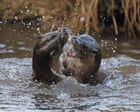
On the Isle of Lismore in Argyll, Scotland, naturalist Cal Flyn documented an intense territorial encounter between otters, capturing the visceral soundscape of these marine mammals in conflict. The encounter reveals how Eurasian otters communicate aggression and dominance through vocalizations that carry across the Scottish coastline.
Flyn heard the otters before spotting them. High-pitched, repeated calls resembling neither human nor animal alone filled the air. The sounds ranged between wailing, trilling, and howling, a complex repertoire of warbling ululations. The vocalizations carried enough volume to travel a mile across open water, indicating the intensity of the animals' interaction.
Eurasian otters (Lutra lutra) inhabit Scotland's freshwater and coastal systems after near extinction in the mid-twentieth century. Hunting, water pollution from pesticides like DDT, and habitat destruction pushed the species to the brink. Since the 1970s, strict legal protections under the Wildlife and Countryside Act 1981 and subsequent European legislation have allowed populations to recover. Scotland now hosts one of the healthiest otter populations in Europe, with current estimates suggesting several thousand individuals across lochs, rivers, and coastal areas.
Otter territoriality drives much of their behavioral complexity. Males maintain territories spanning several kilometers of shoreline or river system. They mark boundaries with spraints, or feces, deposited on prominent rocks and channels. When rival males or groups encounter one another, confrontation escalates quickly. Territorial disputes can turn violent. Combat involves wrestling, biting, and chasing, with dominant animals driving subordinates from preferred foraging grounds.
The vocalizations Flyn recorded represent communication during such conflict. Otters produce distinct calls for different contexts: mother-pup contact calls differ from alarm calls and territorial displays. During battle, otters emit sharp, repeated barks and warbling cries that telegraph aggression and maintain dominance. These sounds function as acoustic weapons, establishing hierarchy without constant physical contact.
Otters rely on territorial control to access productive feeding zones. Scottish coastal waters and lochs contain rich populations of fish, crustaceans, and mollusks. A secure territory ensures reliable access to prey. Otter populations demonstrate density-dependent territoriality, meaning the size and defensibility of territories adjusts based on local food availability and population density. In productive areas, territories compress. In marginal habitat, they expand dramatically.
The recovery of Scottish otters exemplifies how environmental law and habitat restoration reverse species decline. The Wildlife and Countryside Act granted otters full legal protection in 1981. The Water Environment and Water Services (Scotland) Act 2003 established freshwater quality standards. These regulations reduced pollution inputs that had accumulated in otter tissues, particularly organochlorine pesticides that weakened reproductive success.
Flyn's documentation of otter vocalizations during territorial confrontation offers insight into animal communication that researchers have studied using acoustic monitoring and radio telemetry. The intensity and variety of sounds reveal emotional states and behavioral stakes. These calls persist across generations, part of innate and learned behavioral repertoires that shape otter society.
The presence of otters in sufficient numbers to stage dramatic territorial disputes reflects genuine conservation success. Where otters once faced extirpation, they now thrive in Scottish waters. Their riotous vocalization remains a marker of healthy, stable populations asserting control over productive territory. The hullabaloo Flyn heard marks not conflict alone, but the return of a species to ecological prominence.