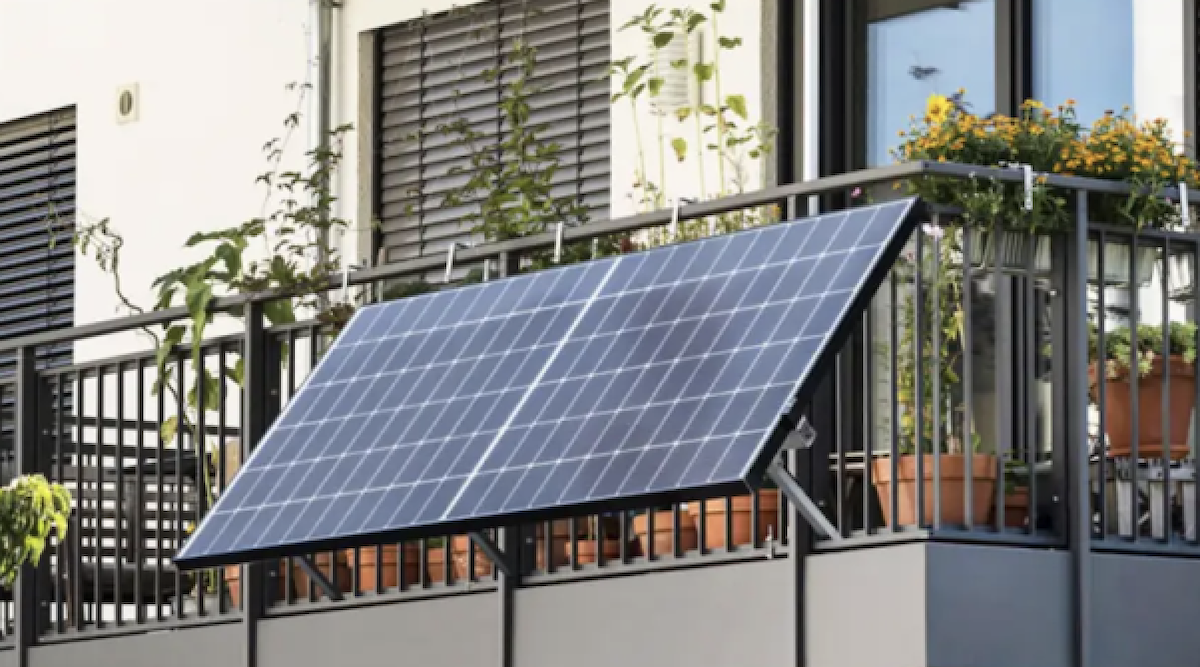
Nine U.S. states have legalized plug-in balcony solar systems, removing regulatory barriers that previously blocked apartment dwellers and renters from installing small rooftop or balcony-mounted panels. Utah, Maine, Virginia, Colorado, Maryland, New Hampshire, Connecticut, Vermont, and New Jersey now permit residents to connect these microgeneration devices directly to standard household outlets without requiring approval from utilities or landlords.
Balcony solar kits, also called solar window systems or plug-and-play panels, generate 300 to 600 watts of electricity per unit. A single panel costs between $300 and $500 and offsets roughly 5 to 10 percent of a household's annual electricity consumption. Installation takes minutes. The systems feed surplus power back into the grid, reducing electricity purchases and lowering utility bills.
This legislative wave addresses a blind spot in residential renewable energy. Rooftop solar remains the dominant form of home energy generation, but it requires ownership of a building and capital investment between $15,000 and $25,000. Renters, apartment residents, and homeowners with shaded roofs lack access to these systems. Balcony solar fills that gap. Germany popularized the technology after changes to national building codes in 2023. The country now hosts over 3 million installations. Austria, France, and the Netherlands followed.
U.S. adoption lagged because utilities and local housing authorities classified balcony panels as safety hazards or unauthorized electrical modifications. Some states required homeowners to obtain utility approval before connecting a single panel to a wall outlet. Others prohibited renters from installing any equipment without landlord permission. These rules existed partly to protect grid stability during moments of peak solar generation and partly due to outdated electrical codes that pre-dated home solar technology.
The nine states that approved legislation took different regulatory paths. Some states exempted systems under 600 watts from utility interconnection requirements. Others established streamlined approval processes that utilities must complete within 30 days. A few states protected tenants by barring landlords from blocking installations without documented safety concerns.
The National Renewable Energy Laboratory estimates that if balcony solar reached just 5 percent of U.S. apartments, it would generate 11 gigawatts of new solar capacity. That equals the output of roughly three large coal plants. The Solar Energy Industries Association tracks ongoing efforts in at least eight additional states to pass similar legislation in 2025 and 2026.
Balcony solar adoption carries minimal environmental risk. The panels produce zero direct emissions. They require no new roof reinforcement or structural modifications. Recycling systems already exist in Europe. Grid operators report no stability problems from millions of distributed microgeneration units feeding power during peak afternoon hours.
The expansion reflects a bottom-up shift in American energy policy. Renters and apartment dwellers built political momentum by forming grassroots advocacy groups. Local utilities gradually accepted the technology as grid management software improved. State legislators responded to constituent demand rather than waiting for federal intervention.
Germany's success demonstrates the ceiling for balcony solar penetration. After two years of legalization, adoption reached roughly 8 percent of German households. Experts attribute higher takeup to better subsidies and lower installation costs. U.S. systems remain approximately 30 percent more expensive than European equivalents due to smaller manufacturing volumes and tariffs on imported components.
This regulatory shift opens solar energy to millions of Americans excluded from traditional rooftop systems. The nine states serve as proof that distributed microgeneration works at scale without destabilizing electricity grids or creating safety hazards.