# Wave Energy Project Survives Trump Budget Cuts as Renewable Transition Accelerates
The PacWave South wave energy test facility received federal funding despite sweeping cuts to wind and solar programs under the Trump administration. The survival of this Oregon-based project signals continued investment in marine renewable technology even as conventional renewables face political headwinds.
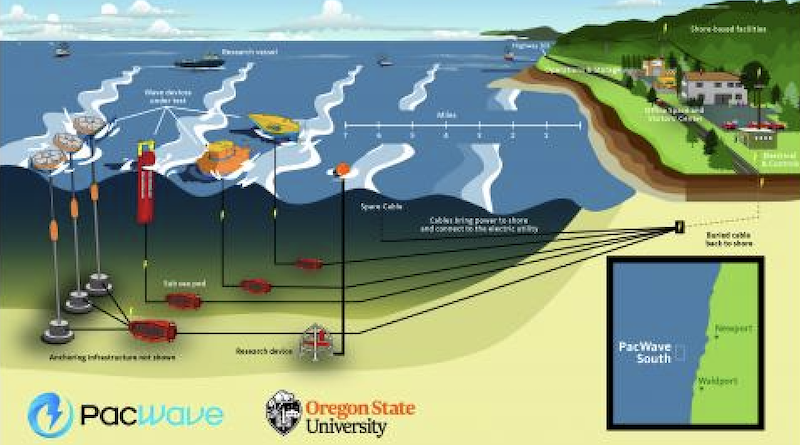
PacWave South, operated by the Pacific Marine Energy Center at Oregon State University, represents one of the few remaining federally backed marine energy initiatives in the United States. The facility tests prototype wave energy converters in the Pacific Ocean off the Oregon coast, collecting performance data that manufacturers need to commercialize devices. Unlike land-based wind and solar installations, wave energy projects generate less political opposition in some regions due to their offshore location and smaller visual footprint.
Wave energy conversion captures the kinetic and potential energy from ocean surface waves and converts it to electricity. The technology operates through various mechanisms, including oscillating water columns, point absorbers, and attenuators. Theoretical estimates suggest that global wave energy resources could generate 2-3 terawatts of power under optimal conditions, though current deployment remains minimal.
The United States currently operates no commercial-scale wave energy facilities. European countries, particularly Scotland and Portugal, have advanced further in wave technology deployment. The European Wave Energy Association reports that prototypes in European waters have demonstrated grid-connected power generation, though costs remain high relative to mature renewable technologies.
PacWave South's continued funding reflects priorities within the Department of Energy's Water Power Technologies Office, which maintains separate budgetary lines from solar and wind programs. The test bed functions as research infrastructure rather than commercial generation, potentially explaining its exemption from broader renewable energy budget reductions. Federal investments in marine energy development continue at approximately $20-30 million annually, though specific 2025 figures remain under review.
Wave energy advocates argue the technology addresses renewable energy's intermittency problem differently than wind or solar. Wave patterns predictable hours in advance allow grid operators to forecast generation more accurately than solar forecasting. Energy density in ocean waves substantially exceeds that of wind at equivalent heights, meaning smaller devices can generate comparable power to larger wind turbines.
Economic barriers persist despite technical progress. Manufacturing wave energy devices requires specialized marine construction expertise. Supply chains for components remain underdeveloped. Capital costs for wave energy installations currently range from $4-10 million per megawatt, compared to approximately $1.3 million per megawatt for offshore wind. These cost differentials have slowed private investment and limited commercial deployment pathways.
The PacWave South facility accommodates up to five full-scale prototype devices simultaneously, providing real-world ocean testing conditions unavailable in laboratories. Previous test deployments included devices from Columbia Power Technologies and Carnegie Clean Energy, generating performance metrics that inform next-generation designs.
Federal support for marine energy diversifies renewable energy portfolios beyond solar and wind dominance. As grid operators seek varied renewable sources with different generation patterns, wave energy capabilities become strategically relevant. The technology requires decades of development and substantial capital deployment before contributing meaningfully to national electricity generation, but sustained testing infrastructure remains essential for long-term commercialization pathways.