# Europe's Transport Electrification Push Targets Energy Independence Beyond 2030
Europe faces a dual imperative. The continent must slash transport emissions while breaking dependence on imported fossil fuels. The EU's post-2030 Renewable Energy Framework offers a pathway, but only if policymakers prioritize electrification alongside renewable deployment.
The stakes are immediate. Europe's recurring energy crises have exposed vulnerability to fuel price volatility and geopolitical disruption. Transport accounts for roughly 29 percent of EU greenhouse gas emissions, with road vehicles responsible for the majority. Heavy reliance on imported oil creates both climate and security liabilities. A strategy that addresses only renewable energy targets without restructuring transport fundamentally misses the sovereignty argument.
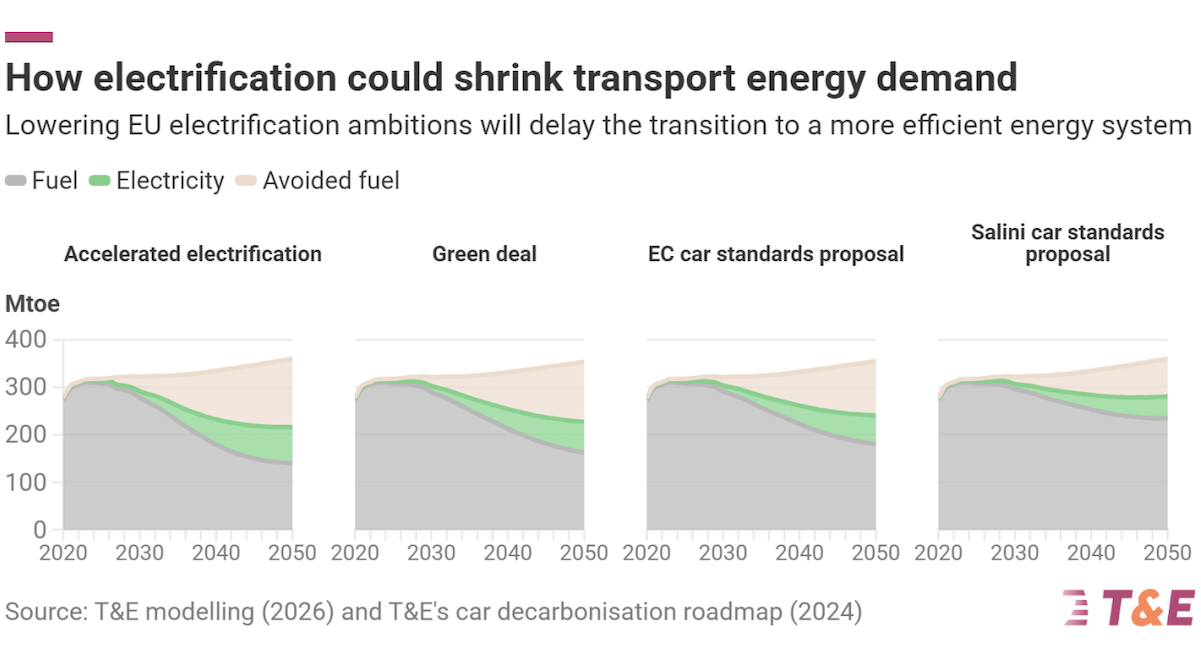
Electrification serves dual purposes. Converting vehicles to battery and electric powertrains eliminates the need for petroleum imports while cutting tailpipe emissions to zero at point of use. Grid electrification powered by renewables closes the loop. When wind and solar generation supplies charging infrastructure, transport becomes genuinely decarbonized rather than merely shifting emissions elsewhere.
The EU currently mandates a 42.5 percent reduction in greenhouse gas emissions by 2030 compared to 1990 levels, with a binding 55 percent target by 2050. The transport sector lags behind. Vehicle electrification rates remain uneven across member states. Norway leads with over 90 percent of new car sales electric. Germany and France exceed 15 percent. Poland, Hungary, and Romania lag below 5 percent. This fragmentation complicates supply chains and prevents economies of scale that lower battery costs across the bloc.
The post-2030 framework must mandate accelerated vehicle electrification timelines. Several EU states already ban combustion engine sales by 2035. Others lack equivalent commitments. Harmonized standards create investor certainty. Manufacturers prioritize markets with clear regulatory signals. Charging infrastructure deployment remains scattered. Public chargers concentrate in wealthy urban centers. Rural and peripheral regions lack adequate networks, deterring adoption in lower-income households and smaller municipalities.
Investment in charging infrastructure must accompany vehicle deployment targets. The European Green Deal allocated funds for alternative fuel infrastructure, but allocations fall short of demand. A coherent post-2030 framework should establish minimum charging density requirements, fund rapid deployment corridors, and incentivize private investment through guaranteed returns.
Grid capacity requires parallel attention. A fully electrified European transport fleet would demand substantial additional electricity generation. Renewable capacity must expand accordingly. The EU's current renewable energy target of 42.5 percent by 2030 sets direction but may prove insufficient if electrification accelerates demand faster than anticipated. Battery storage becomes critical infrastructure. Seasonal storage smooths renewable variability. Pumped hydro, compressed air, and emerging long-duration technologies deserve sustained investment.
Just transition considerations demand inclusion. Regions dependent on fossil fuel production face economic disruption. Coal mining areas in Poland, Romania, and Germany require retraining programs and economic diversification funding. Supply chain resilience matters. Battery production remains concentrated in China and Asia. European capacity building reduces both geopolitical risk and cost inflation.
The coming renewable energy framework should move beyond percentage targets toward concrete electrification commitments. Member states need binding obligations for vehicle uptake, charging infrastructure deployment, and grid modernization. Energy sovereignty requires that Europe powers its own mobility. Transport electrification, integrated with renewable deployment, achieves that goal while eliminating climate-damaging fuel imports.