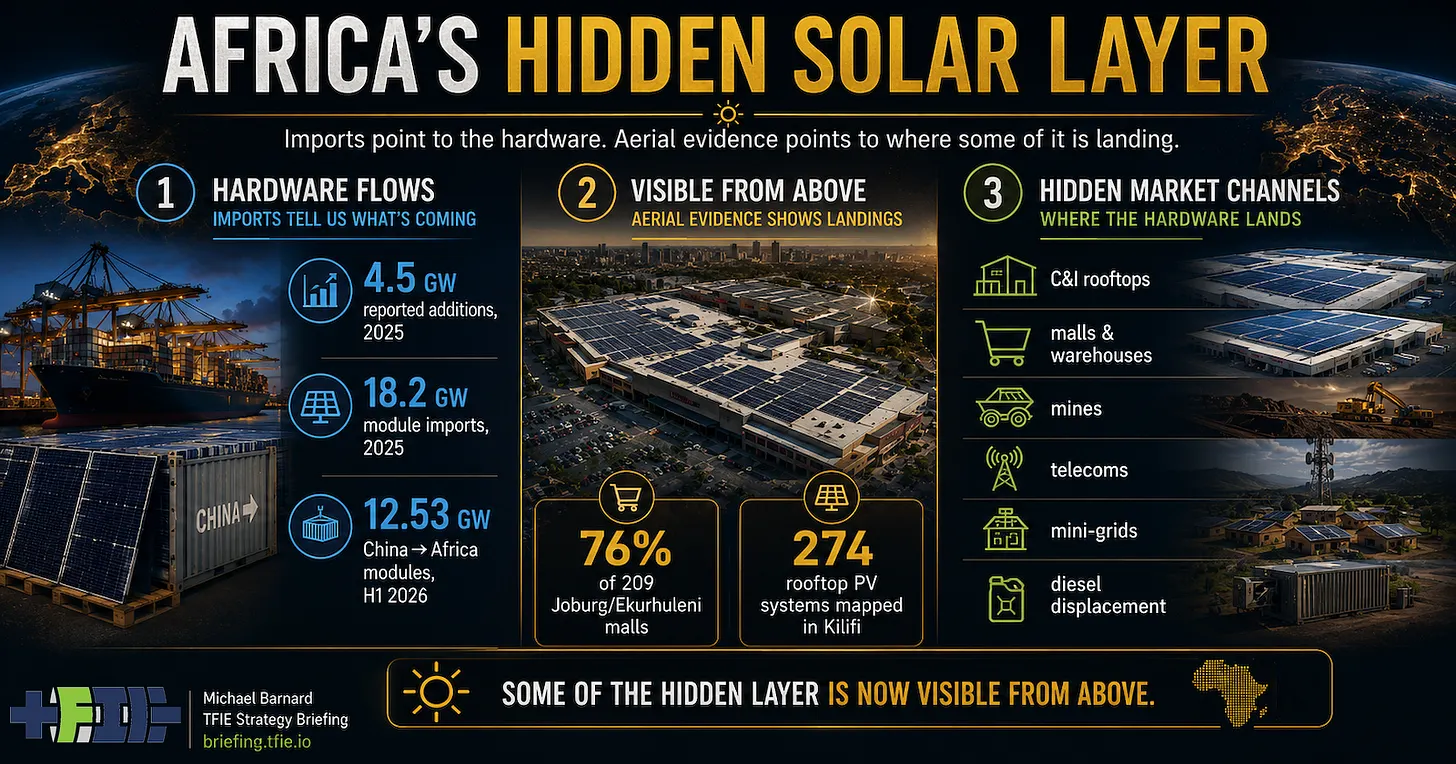
Africa deployed roughly 4.5 gigawatts of solar capacity in 2025 according to official figures, yet the continent imported 18.2 gigawatts of solar modules during the same year. This fourfold discrepancy reveals a hidden acceleration in distributed solar installations that national statistics fail to capture.
The gap between imports and recorded deployments points to a surge in rooftop solar systems installed by households, small businesses, and off-grid operators across Africa. These installations often bypass formal reporting channels. Warehouse and port stockpiles account for some inventory buildup, but analysts say the differential is too large to explain through logistics alone. Much of the imported equipment has already reached end users.
Distributed solar adoption accelerates fastest in countries with unstable grid power and rising electricity costs. Nigeria, Kenya, Tanzania, and South Africa lead this trend. In Nigeria alone, rolling blackouts spanning 12-14 hours daily drive residential and commercial installations. Solar retailers report 60-80 percent year-over-year growth in rooftop system sales across major African cities. Grid operators do not systematically track these deployments. Most transactions occur through informal channels without permits or metering connections to the national power system.
The scale of this gap matters for climate accounting and energy planning. Official statistics undercount Africa's renewable capacity additions by as much as 400 percent, according to energy analysts examining customs data and industry reports. This distortion ripples through international climate frameworks. Nations report renewable energy progress to the United Nations Framework Convention on Climate Change based on installed grid-connected capacity. Rooftop systems and microgrid installations remain invisible to these reports.
For utilities and policymakers, the hidden boom presents both opportunity and challenge. Distributed solar reduces grid demand and deferrs expensive transmission infrastructure investments. It also fragments revenue streams for state-owned power utilities already struggling with collection rates below 70 percent in several countries. South Africa's Eskom reported an estimated 2.5 GW of unlicensed rooftop solar capacity operating in its service territory as of mid-2025, competing with utility sales.
Several African governments now recognize the statistical blindspot. Tanzania's energy regulator launched a voluntary registration program for rooftop installers in 2024. Kenya introduced tax incentives for reported solar installations, aiming to pull informal systems into official records. The AU Commission and regional development banks increasingly fund solar deployment tracking studies, using satellite imagery and ground surveys to map actual capacity.
Industry observers expect the import-deployment gap to continue widening through 2026. Manufacturing costs for solar modules remain near historic lows. Supply chains from Southeast Asia now route directly to African ports, bypassing Western distributors. Falling equipment prices accelerate adoption among middle-class households priced out of grid electrification in prior years.
This disconnect between statistics and reality underscores a broader challenge for African energy transition planning. Decentralized renewable systems outpace centralized infrastructure investment. Without accurate deployment data, governments cannot optimize grid integration, plan complementary battery storage, or design equitable energy policies. Closing this data gap has become essential for coherent energy governance across the continent.