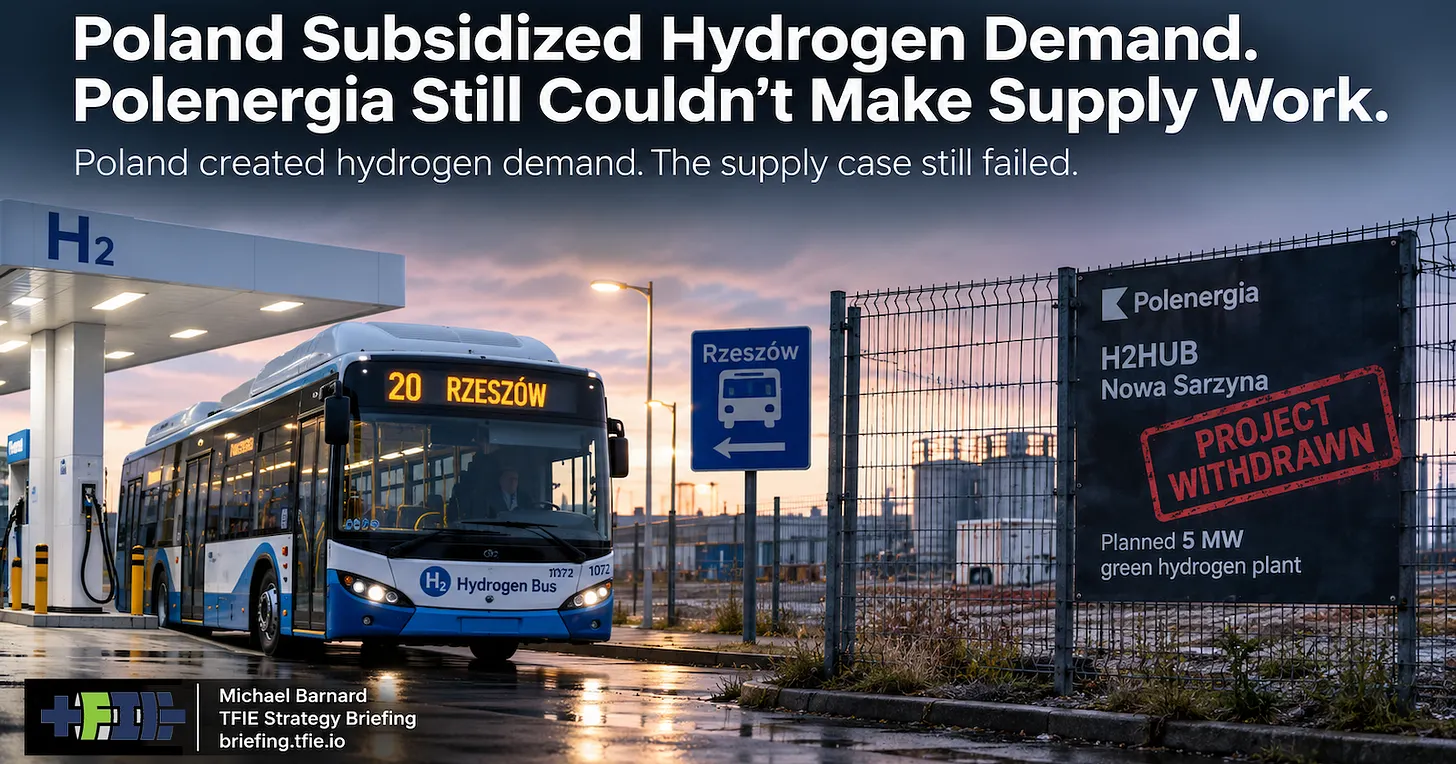
Poland assembled the policy infrastructure that hydrogen advocates have long demanded. Public subsidies purchased hydrogen buses for city transit. Government funding supported refueling stations. Renewable hydrogen projects received direct financial backing. By April 2026, Polish cities operated 153 registered hydrogen buses, with 140 already deployed across transit systems.
This represented a genuine demand signal. Yet Polenergia, Poland's major energy company, withdrew from hydrogen supply anyway.
The withdrawal exposes a gap between policy creation and market viability. Governments can mandate procurement and fund infrastructure. They cannot force private companies to operate at losses or thin margins. Polenergia's decision suggests that even with subsidized demand in place, the economics of renewable hydrogen production remain uncompetitive at scale.
Hydrogen buses produce zero tailpipe emissions, making them attractive for cities targeting air quality and carbon reduction goals. Poland chose buses as a deployment mechanism, mirroring strategies in Germany and other EU nations. The National Centre for Research and Development (NCBR) and Polish transport ministries coordinated funding streams. Bus manufacturers ramped production. Cities signed procurement contracts.
Supply never materialized at the required scale.
Renewable hydrogen production requires electrolyzers powered by wind or solar electricity. The process consumes significant energy, raising production costs. European hydrogen prices typically run between 8 to 12 euros per kilogram, versus 1.5 to 2 euros for hydrogen produced from natural gas. Even with government subsidies applied to demand, the profit margin on green hydrogen production remained too narrow. Polenergia apparently calculated that serving Polish bus operators would not generate acceptable returns.
This pattern repeats across Europe. Germany's hydrogen strategy targets 10 gigawatts of electrolyzer capacity by 2030. National support mechanisms exist. Yet investment lags projections. France's Genvia, a green hydrogen startup backed by public funding, shuttered operations in 2024. Denmark's Nel Hydrogen reduced capacity at its flagship electrolyzer plant.
Poland's situation carries additional complexity. The country still derives roughly 20 percent of electricity from coal. Renewable energy capacity expanded, but baseload remains fossil-dependent. This matters because hydrogen purity and carbon intensity depend entirely on electricity source. Buses fueled by hydrogen made from grid power reflect the grid's generation mix. Polish hydrogen lacked the clean credentials that European environmental standards increasingly demand.
Polenergia's exit also reflects corporate strategy. The company pursued natural gas infrastructure expansion in Poland. Investing capital in renewable hydrogen production conflicts with those priorities. Management chose the established business model over an emerging one with uncertain profitability timelines.
The buses themselves remain operational. Cities continue running hydrogen transit fleets. But expansion stalls without reliable supply. This creates a perverse outcome. Poland created the demand mechanism but cannot sustain the supply chain. Buses may eventually revert to diesel or electric operation, negating the original hydrogen transition investment.
The lesson extends beyond Poland. Demand creation alone proves insufficient. Governments must also ensure supply-side economics work. This requires either substantially higher hydrogen prices passed to consumers, continuous subsidies for production, or breakthroughs in electrolyzer efficiency and cost reduction. Germany, France, and other nations now acknowledge this reality and adjust hydrogen timelines accordingly. Poland confronts the same constraints.