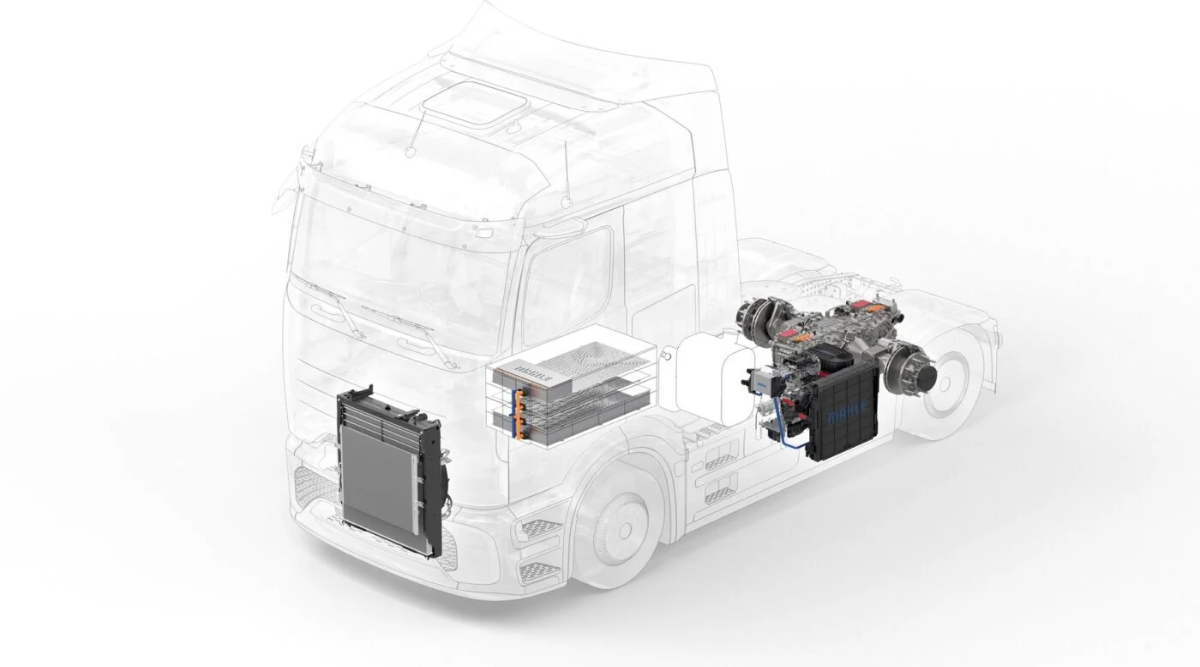
German automotive supplier Mahle has introduced a range extender system designed to address the range limitations plaguing battery electric heavy-duty trucks. The technology represents a pragmatic engineering response to a persistent problem in commercial trucking: fully loaded semis cannot reliably traverse long distances or steep grades on battery power alone, even with optimized aerodynamics and large battery packs.
Range extenders operate as onboard generators, typically powered by internal combustion engines or fuel cells, that recharge the battery pack during operation. This hybrid approach allows trucks to maintain electric drive while extending operational range beyond what batteries alone can provide. For long-haul trucking, this matters. A truck that cannot reach a charging station becomes economically obsolete.
The Tesla Semi, despite years of development and promises of widespread deployment, remains limited in real-world availability. Its maximum rated range of 500 miles assumes optimal highway conditions with moderate loads and favorable terrain. Loaded semis ascending mountain passes face substantially lower effective range, sometimes dropping to 200 miles or less depending on grade and weight. Mahle's range extender addresses this gap directly.
The company's system targets the heavy-duty segment where battery-only solutions face the greatest technical barriers. Long-haul trucking depends on consistent performance across varied terrain and climates. A truck stranded mid-route represents lost revenue for carriers and broken supply chains for shippers. Range anxiety in personal vehicles irritates consumers. In commercial trucking, it kills business models.
Mahle's engineering approach reflects industry consensus: battery technology alone cannot meet the performance envelope required for all trucking applications within the next decade. Battery density continues improving, but physics imposes limits. Adding battery capacity increases weight, which increases rolling resistance and reduces efficiency, creating diminishing returns. A 100-kilowatt-hour battery pack weighs roughly 600 pounds. Scaling to 300 kilowatt-hours to solve range problems adds nearly a ton of dead weight that reduces payload capacity and increases fuel consumption.
Range extenders avoid this trap. A small onboard generator adds weight but maintains payload capacity while solving the range problem. Carriers can run electric drive when conditions permit, capturing efficiency gains from electric motors, while the extender handles edge cases and long-haul routes.
The technology does not eliminate fossil fuel dependence entirely. Trucks still burn fuel in the extender's engine. But efficiency gains from electric drivetrains and regenerative braking mean the system uses substantially less fuel than conventional diesel trucks. Mahle's system could reduce emissions by 30 to 50 percent compared to traditional semis, depending on duty cycle and extender configuration.
This approach diverges from purist zero-emission mandates but aligns with engineering reality. The European Union has set stringent CO2 reduction targets for heavy vehicles. Battery-only mandates risk pushing carriers toward older, dirtier trucks kept in service longer rather than replaced with advanced hybrid systems. Pragmatic emissions policy accommodates proven interim technologies.
Mahle's range extender enters a crowded development landscape. Hyliion, Lion Electric, and others pursue similar hybrid heavy-truck architectures. The company's entrance signals growing industry acceptance that the transition to zero-emission trucking requires an intermediate phase. Fully electric trucks will eventually dominate. Until then, efficient range extenders represent the fastest path to meaningful emissions reductions in commercial trucking.